- Nuku‘alofa
- Haveluloto
- Tofoa-Koloua
- Popua
- Lapaha
- Pea
- Fangale’ounga
- Neiafu
- Nukunuku
- Houma
- Holopeka
- Pangai
- Holonga
- ’Alele’uta
- Hihifo
- Ha'atu'a
- Free Church of Tonga
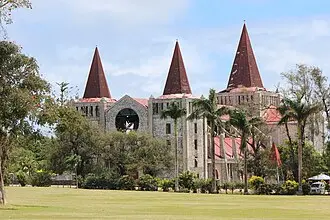
The Free Church of Tonga (Tongan: Siasi ʻo Tonga Tauʻatāina) is a Christian denomination of Methodist extraction in the Kingdom of Tonga. The Church was established in 1885 by King George Tupou I and his government at Lifuka, Ha'apai, as a nationalist reaction to attempts at colo
- Vavaʻu
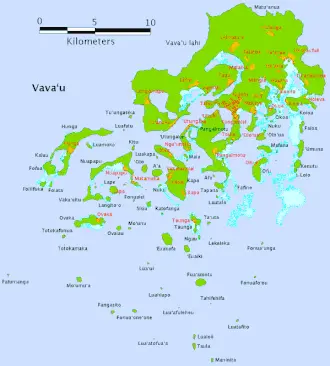
Vavaʻu is an island group, consisting of one large island (ʻUtu Vavaʻu) and 40 smaller ones, in Tonga. It is part of Vavaʻu District, which includes several other individual islands. Vavaʻu rises 204 m (669 ft) above sea level at Mount Talau. The capital is Neiafu, situated at t
- St. Mary's Cathedral, Tonga
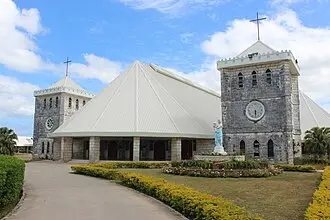
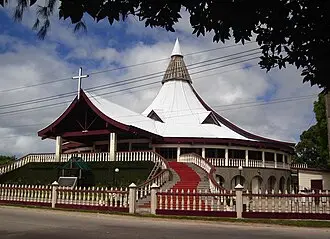
The Cathedral of St. Mary (or simply Cathedral of Nukualofa and also alternately called the Cathedral of the Immaculate Conception and locally in Tongan: Malia Tupu Imakulata) is a religious building located on Vuna Road in the town of Nukualofa, capital of the Kingdom of Tonga a
- Masilamea
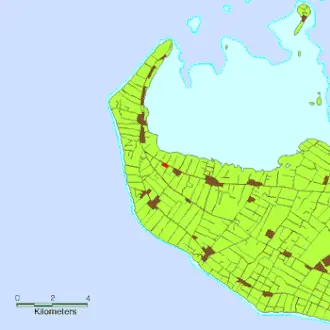
Masilamea is a village on the island of Tongatapu in Tonga. The village had a population of 284 at the 2021 census.
- Foa
Foa is an island in the Haʻapai group in Tonga. It is the second-largest island in the group, after Tofua, with an area of 13.3 km2 (5.1 mi2) and a maximum elevation of 20 m (66 ft). The population as of the 2021 census was 1,332. It is linked to adjacent Lifuka by a causeway. Fo
- Tongatapu
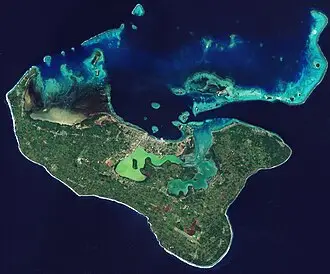
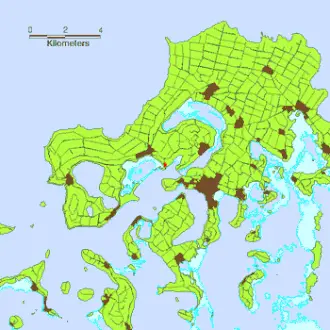
Tongatapu is the main island of Tonga and the site of its capital, Nukuʻalofa. Approximately 260 square kilometres (100 square miles) in size, it is located in Tonga's southern island group, to which it gives its name and it is the country's most populous island, with 74,611 resi
- Nuku'alofa Tonga Temple
The Nukuʻalofa Tonga Temple is a temple of the Church of Jesus Christ of Latter-day Saints in Nukuʻalofa, Tonga. It was announced on April 2, 1980, by church president Spencer W. Kimball during a news conference. It is the first in Tonga and the 23rd operating temple worldwide. A
- Lifuka
Lifuka Island is an island in Tonga. It sits approximately 170 kilometres north-east of the capital, Nukuʻalofa, and covers an area of 12.2 square kilometres. The terrain of Lifuka Island is exceptionally flat. The highest point on the island reaches 22 metres above sea level. I
- ʻEua
ʻEua (Tongan pronunciation: [ʔe.ˈu.a]), formerly Middelburg Island, is an island in the kingdom of Tonga. It is close to Tongatapu, but forms a separate administrative division. It has an area of 87.44 km2 (33.76 sq mi), and a population in 2021 of 4,903 people. The island leads
- Niuatoputapu
Niuatoputapu (The Sacred Niua) is a volcanic island in the island nation of Tonga, Pacific Ocean. Its highest point is 157 metres (515 ft), and its area is 16 square kilometres (6.2 sq mi). Its name means sacred island. Other names for the island are Traitors Island or Keppel I
- Haʻapai
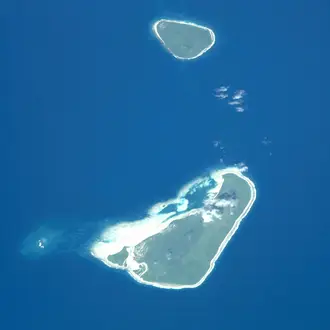
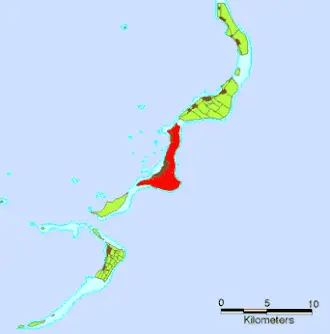
Haʻapai is a group of islands, islets, reefs, and shoals in the central part of Tonga. It has a combined land area of 109.30 square kilometres (42.20 sq mi). The Tongatapu island group lies to its south, and the Vavaʻu group lies to its north. Seventeen of the Haʻapai islands are
- Niuafoʻou
Niuafoʻou (meaning 'many new coconuts') is the northernmost island in the kingdom of Tonga. One of the Niua Islands, it is located in the southern Pacific Ocean between Fiji and Samoa, 574 km (357 mi) north of Tongatapu island group and 337 km (209 mi) northwest of Vavaʻu. It is
- Basilica of St. Anthony of Padua, Tonga
The Basilica of St. Anthony of Padua or simply Church of St. Anthony of Padua, is a Catholic church in the Taufa'ahau road in the town of Nukualofa, the capital of the Kingdom of Tonga in the Pacific Ocean.
- Vaimalō
Vaimalō, is a village in the western district of Vavaʻu in Tonga. The population is 114.
- Hule fortress
The Hule Fortress was a stronghold in Nukunuku on the island of Tongatapu in Tonga. Its capture in January 1837 during a religious war saw the massacre of all three hundred inhabitants. The fortress was owned by Tu'ivakano, the chief of Nukunuku, who had accepted Christianity. Wh
- Faleloa
Faleloa is a settlement in Foa island, Tonga. It had a population of 380 in 2016.
- Haʻamonga ʻa Maui
Haʻamonga ʻa Maui ("The Burden of Maui") is a stone trilithon located in Tonga, on the eastern part of the island of Tongatapu, in the village of Niutōua, in Heketā. It was built in the 13th century by King Tuʻitātui in honor of his two sons. The monument is sometimes called the
- Houma (Tongatapu)
Houma is a village in Tongatapu, Tonga. It contains Mapu a Vaea. It had a population of 2086 in 2016.
- Niua Islands
Niua is a division of the Kingdom of Tonga, namely the northernmost group of islands. It consists of three islands (Niuafoʻou, Niuatoputapu and Tafahi) which together have an area of 71.69 km2 and a population of 1,150. The largest village is Hihifo on Niuatoputapu. Piu'o Tafahi
- Koulo
Koulo is a settlement in the north-west area of Lifuka island, Tonga. The population is 171.
- Niuafoʻou Airport
Niuafoʻou Airport (IATA: NFO, ICAO: NFTO), also known as Kuini Lavinia Airport, is an airport in Niuafoʻou, Tonga. It was built in 1983. Its inauguration was celebrated with an issue of stamps.
- Malaʻekula
Malaʻekula (lit. 'Red square'), alternatively spelled Malaʻe Kula, is the royal burial grounds located in central Nukuʻalofa, Tonga, reserved solely for Tongan monarchs, their spouses and their children. Extended family members (such as cousins, nephews, nieces and in-laws) are b
- Falevai
Falevai is a settlement in the Vava'u islands in Tonga. The name Falevai, if translated into English means "water house." The name was given because of how the seas and the oceans surrounding the houses. Falevai's most famous names are lafa 'i tua and kuli fe kai. The settlement
- Muʻa (Tongatapu)
Muʻa is a small town in the Hahake (eastern) district on the island of Tongatapu, and it was for centuries the ancient capital of the Tuʻi Tonga Empire. It is divided in the villages Lapaha and Tatakamotonga, is close to Talasiu and famous for the ancient langi (royal burial tomb






By continuing to use the Platform, you agree to cookies and similar technologies. If you do not agree, discontinue use.
VIDI Privacy Policy
·
VIDI Cookie Policy
By continuing to use the Platform, you agree to cookies and similar technologies. If you do not agree, discontinue use.
VIDI Privacy Policy
·
VIDI Cookie Policy