- Braşov
- Cluj-Napoca
- Bucharest
- Stupini
- Iaşi
- Craiova
- Oradea
- Suceava
- Bistriţa
- Sfântu Gheorghe
- Vaslui
- Botoşani
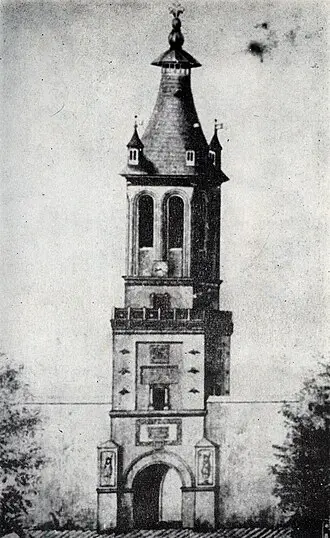
- Turnul Colței
Turnul Colței (also Turnul Colțea or Colții) was a tower located in Bucharest, Wallachia, now in Romania. Its initial purpose was to be used as a bell tower — its 1,700 kg (3,700 lb) bell, was moved to the Sinaia Monastery after the tower was demolished. It was also meant to serv
- Iași
Iași (UK: YASH(-ee), US: YAHSH(-ee), Romanian: [ˈjaʃʲ] ; also known by other alternative names), also sometimes referred to historically as Jassy (UK: YASS-ee, US: YAH-see), is the third most-populous city in Romania and the seat of Iași County. Located in the historical regi
- National Museum of Transylvanian History
The National Museum of Transylvanian History (Romanian: Muzeul Național de Istorie a Transilvaniei, Hungarian: Erdélyi Történelmi Múzeum) is a history and archaeology museum in the city of Cluj-Napoca, Romania. It features a permanent exhibition, as well as temporary exhibitions,
- Tâmpa (Brașov)
Tâmpa (German: Zinne, or Kapellenberg; Hungarian: Cenk; Latin: Mons Cinum) is a mountain, part of the Postăvarul Massif, located in the southern part of the Eastern Carpathians (alternatively categorized as in the Curvature Carpathians) and almost entirely surrounded by the city
- National Theater Craiova
The National Theater Craiova, formally named after playwright Marin Sorescu (Romanian: Teatrul Național Marin Sorescu din Craiova, TNC), is a state-run institution for performing arts in Craiova, Romania. It endures as the center of theatrical life in all of Oltenia, and overall
- Varat Eyalet
Varat Eyalet (also known as Pashaluk of Varat or Province of Varat; Ottoman Turkish: ایالت وارد; Eyālet-i Vārad) was an administrative territorial entity of the Ottoman Empire formed in 1660. Varat Eyalet bordered Ottoman Budin Eyalet in the west, Temeşvar Eyalet in the southwest
- Popăuți Monastery
Popăuţi Monastery is a monastery located in Botoșani, Romania, on Ştefan cel Mare Street no. 41, near the train station. It was founded in 1496 by the voivode Stephen the Great (1457-1504). It is listed as a historic monument by Romania's Ministry of Culture and National Identity
- Medieval Seat Fortress of Suceava
The Medieval Seat Fortress of Suceava (Romanian: Cetatea Medievală de Scaun a Sucevei or Cetatea Sucevei; German: Sotschen Festung, Der Fürstensitz von Suceava, Die Fürstenburg von Suceava, or Festung Suceava) is a fortified castle in the middle-sized town of Suceava, the county
- Entry of the Theotokos into the Temple Church, Bistrița
"The Presentation of the Blessed Virgin Mary as known in Eastern Churches as The Entry of the Most Holy Theotokos into the Temple (Romanian: Biserica Intrarea Maicii Domnului în Templu) is the former church of St. Andrew Franciscan Convent (Minorites) from Bistrița town, in hist
- Battle of Vaslui
The Battle of Vaslui (also referred to as the Battle of Podul Înalt or the Battle of Racova) was a battle that was fought on 10 January 1475, between Stephen III of Moldavia and the Ottoman governor of Rumelia, Hadım Suleiman Pasha. The battle took place at Podul Înalt ("the High
- Reformed Church, Ghidfalău
The Reformed church of Ghidfalău is a church on the edge of the village, on the hills surrounding the floodplain of the Olt River. It is a stronghold from the Middle Ages, which had an important role in the defence of the local citizens. It is one of those fortresses in Háromszé
- Transilvania University of Brașov
Transilvania University of Brașov (Romanian: Universitatea Transilvania din Brașov; UNITBV, also stylised UniTBv) is a higher education and research institution in Brașov, Romania which comprises 18 faculties, with a number of over 20,880 students and over 700 teaching staff memb
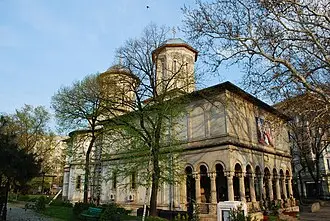
- New St. George Church
New St. George Church (Romanian: Biserica Sfântul Gheorghe Nou) is a Romanian Orthodox church located in Bucharest, Romania, along the city center's main north-south thoroughfare, where it intersects the Lipscani area. It is dedicated to Saint George. The church is associated wit
- Roman Catholic Diocese of Iași
The Diocese of Iași (or Latin: Dioecesis Iassiensis, Romanian: Episcopia Romano-Catolică de Iași, Hungarian: Jászvásári Egyházmegye, Polish: Diecezja Jassy) is a Latin Church ecclesiastical territory or diocese of the Catholic Church in Romanian Western Moldavia. It is a suffraga
- Cluj-Napoca Piarists' Church
The Piarist Church (Romanian: Biserica Piariștilor, also known as the Jesuit Church (Biserica Iezuiților) or the University Church (Biserica Universității); Hungarian: piarista templom), located at 5 Str. Universității, Cluj-Napoca, Romania, and dedicated to the Holy Trinity, was
- Biserica Neagră
The Black Church (Romanian: Biserica Neagră, German: Die Schwarze Kirche, Hungarian: Fekete templom), stands in the city of Brașov in south-eastern Transylvania, Romania. It was built by the local Transylvanian Saxon (German) community of the city during medieval times and repres
- Cathedral of Saint Demetrius, Craiova
The Cathedral of Saint Demetrius (Romanian: Catedrala Sfântului Dumitru) is a Romanian Orthodox cathedral, see of the Metropolis of Oltenia. It is located at 14 Matei Basarab Street, Craiova, Romania, in the historic region of Oltenia. There was likely a church on the site by the
- Baroque Palace of Oradea
The Baroque Palace of Oradea (Romanian: Palatul Baroc din Oradea; Hungarian: Nagyváradi barokk palota), also known as the Roman Catholic Episcopal Palace of Oradea (Romanian: Palatul Episcopiei Romano-Catolice din Oradea; Hungarian: Nagyváradi római katolikus püspöki palota), of
- Suceava North railway station
Suceava North railway station (Romanian: Gara Suceava Nord; German: Itzkany Bahnhof), also known as Ițcani, is a railway station located in Suceava, Romania, completed in 1871. Originally part of Ițcani village (now a suburb of Suceava), it is located at No. 4, Gării Street. The
- Bistrița (Someș)
The Bistrița (Romanian: [ˈbistritsa] ; Hungarian: Beszterce) is a river in the Romanian region of Transylvania, Bistrița-Năsăud County. It is sometimes referred to as Bistrița ardeleană, 'the Transylvanian Bistrița'. At Sărata village near the city of Bistrița it flows into the Ș
- Beheading of St. John the Baptist Church, Vaslui
The Beheading of St. John the Baptist Church (Romanian: Biserica Tăierea Capului Sfântului Ioan Botezătorul) is a Romanian Orthodox church located at 58 Ștefan cel Mare Street, Vaslui, Romania. It is dedicated to the Beheading of John the Baptist. The church was originally founde
- Ghidfalău
Ghidfalău (Hungarian: Gidófalva, Hungarian pronunciation: [ˈɡidoːfɒlvɒ]) is a commune in Covasna County, Transylvania, Romania composed of four villages: Angheluș (Angyalos), Fotoș (Fotosmartonos), Ghidfalău, and Zoltan (Érfalvazoltán).
- Brașov
Brașov (UK: , US: ; Romanian: [braˈʃov] ; German: Kronstadt, also Brasau; Hungarian: Brassó [ˈbrɒʃːoː]; Latin: Corona; Transylvanian Saxon: Kruhnen) is a city in Transylvania, Romania and the county seat (i.e. administrative centre) of Brașov County. According to the 2021 census,
- Great Synagogue (Bucharest)
The Great Synagogue (Romanian: Sinagoga Mare), also known as the Great Polish Synagogue, is a Jewish congregation and synagogue, located at 11 Vasile Adamache, in the Old Jewish District of Bucharest, Romania. The synagogue was completed in 1847 by the Polish-Jewish community. Th




By continuing to use the Platform, you agree to cookies and similar technologies. If you do not agree, discontinue use.
VIDI Privacy Policy
·
VIDI Cookie Policy
By continuing to use the Platform, you agree to cookies and similar technologies. If you do not agree, discontinue use.
VIDI Privacy Policy
·
VIDI Cookie Policy