- Praga Północ
- Kraków
- Wrocław
- Gdańsk
- Ochota
- Warsaw
- Śródmieście
- Lublin
- Toruń
- Piekary Śląskie
- Żoliborz
- Łódź
- Bytom
- Targówek
- Poznań
- Bydgoszcz
- Wola
- Chorzów
- Będzin
- Praga Południe
- Śródmieście
- Mokotów
- Psie Pole
- Siemianowice Śląskie
- Warsaw Uprising (1794)
The Warsaw Uprising of 1794 or Warsaw Insurrection (Polish: insurekcja warszawska) was an armed insurrection by the people of Warsaw early in the Kościuszko Uprising. Supported by the Polish Army, the uprising aimed to throw off control by the Russian Empire of the Polish capital
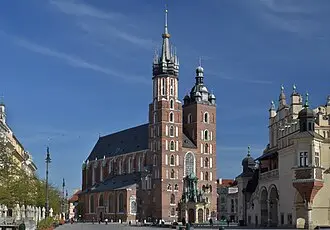
- Basilica of the Assumption of the Blessed Virgin Mary, Kraków
The Basilica of the Assumption of the Blessed Virgin Mary (Polish: Bazylika Wniebowzięcia Najświętszej Marii Panny), known colloquially as the St. Mary's Basilica (Polish: Bazylika Mariacki), is a historic Roman Catholic parish church located at Mariacki Square at the north-easte
- Museum of the University of Wrocław
The Museum of the University of Wrocław is a museum in Wrocław (Poland) displaying many of the historical objects of the University of Wrocław. Museum was established on 6 August 1992 as the result of converting the Museum Collection Department of the Archives of the University o
- EC1 Łódź – City of Culture
EC1 Łódź – City of Culture is a cultural institution in Łódź, located within the revitalised urban complex which previously housed the first power plant in the city. Buildings belonging to the power plant have been revitalized and adapted to serve as centres of culture and scienc
- Poznań Old Town
Poznań Old Town is the centermost neighbourhood of the city of Poznań in western Poland, covering the area of the once walled medieval city of Poznań. It is called Stare Miasto in Polish, although that name may also refer to the wider administrative district of Stare Miasto, whic
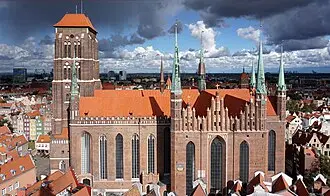
- St. Mary's Church, Gdańsk
St. Mary's Church (Polish: Bazylika Mariacka, German: St. Marienkirche) is a Roman Catholic church and co-cathedral located in central Gdańsk, Poland. Completed in 1502 in the Brick Gothic architectural style, it is one of the world's largest brick churches and among the city's m
- Majdanek concentration camp
Majdanek (or Lublin) was a Nazi concentration and extermination camp built and operated by the SS on the outskirts of the city of Lublin during the German occupation of Poland in World War II. It had three gas chambers, two wooden gallows, and some 227 structures in all, placing
- Grodzka Street, Bydgoszcz
Grodzka Street is a historical street in Old Town of Bydgoszcz, Poland. The street is located in the northern part of the Old Town: it stretches along Brda River waterfront, following an east–west axis. The street starts at the intersection with Bernardyńska street and ends at Ta
- St. Mary's Church, Katowice
St. Mary's Church in Katowice (Polish: Kościół Mariacki w Katowicach) is one of the oldest churches in Katowice, Poland, dating back to 19th century. This neo-Gothic church is located in the Śródmieście district. The architectural design was entrusted to Alexis Langer, a renowned
- Statue of Władysław Bartoszewski (Sopot)
The statue of Władysław Bartoszewski (Polish pronunciation: [vwaˈdɘ̟.swaf bar.tɔˈʂɛf.skʲi]; Polish: Pomnik Władysława Bartoszewskiego) is a monument in Sopot, Poland, within the neighbourhood of Lower Sopot. The statue is placed at a small urban square at the intersection of Kośc
- Cathedral of the Protection of the Blessed Virgin Mary in Radom
The Cathedral of the Protection of the Blessed Virgin Mary in Radom (Polish: Katedra Opieki Najświętszej Maryi Panny w Radomiu) is a Catholic cathedral designed by Józef Pius Dziekoński (1844–1927), located on Henryka Sienkiewicza Street in Radom, Poland. The Radom Cathedral Muse
- 100 Sobieskiego Street
100 Sobieskiego Street, nicknamed "Spyville" (Polish: "Szpiegowo"), is a housing complex located in the Sielce neighborhood of the Mokotów district of Warsaw, Poland. It was developed during the time of the People's Republic of Poland in the late 1970s as accommodation for Soviet
- Gleiwitz incident
The Gleiwitz incident, or Gliwice incident (German: Überfall auf den Sender Gleiwitz; Polish: prowokacja gliwicka), was a false flag attack on the radio station Sender Gleiwitz in Gleiwitz (then Germany and now Gliwice, Poland) staged by Nazi Germany on the night of 31 August 193
- Rzeszów Castle
Rzeszów Castle is one of the main landmarks of Rzeszów, Poland. It was rebuilt between 1902 and 1906, and it is located on the former grounds of the castle of the House of Lubomirski. The castle is located between Aleja Pod Kasztanami and Aleja Lubomirski, Chopin Street, Śreniawi
- Statues of Kargul and Pawlak
The statues of Kargul and Pawlak (Polish pronunciation: [ˈkar.ɡul … pav.lak]; Polish: Pomnik Kargula i Pawlaka) is a bronze monument in Toruń, Poland, placed at the Chief Technical Organisation Square, at the corner of Chełm Road and Red Road, within the district of Chełmińskie P
- Guido Mine and Coal Mining Museum
The Guido mine (Polish: Kopalnia Guido, formerly Zabytkowa Kopalnia Węgla Kamiennego) is a historic deep coal mine and museum in Zabrze, Silesia, Poland. The museum is an Anchor point on the European Route of Industrial Heritage. This is an object of cultural heritage inscribed i
- Bytom Synagogue
The Bytom Synagogue or Beuthen Synagogue was a former Reform Jewish congregation and synagogue, located in Beuthen, in the Prussian Province of Silesia. The town is now located in present-day Bytom, Poland, a border–town between Germany and the Second Polish Republic prior to Ger
- Neon Museum, Warsaw
Neon Museum, also the Museum of Neon (Polish: Muzeum Neonów) is a museum located in Warsaw. The institution documents and protects Polish and Eastern Bloc light advertisements created after World War II. It is the first in Poland and one of the few museums of neon signs in the wo
- Weaver's House Museum
The Weaver's House (Polish: Dom Tkacza) is a unique example of the 18th-century craftsman architecture. Located in Bielsko-Biała, it is situated in Stare Bielsko in a log cabin with its characteristic hay store. The building is a museum branch belonging to the Museum in Bielsko-B
- Temple of Divine Providence
The Temple of Divine Providence (Polish: Świątynia Opatrzności Bożej) is a principal Roman Catholic church in Poland, located within the Wilanów district of Warsaw. The backstory of its construction began in the 18th century. The Temple is conceived as a national and religious sy
- Chudów
Chudów ([ˈxuduf], German: Chudow, Chutow) is a village in Poland, situated in Gliwice County within the municipality of Gmina Gierałtowice, Silesian Voivodeship, in the historical region of Silesia. From 1945 to 1954, Chudów served as the seat of the Chudów commune. Between 1954
- Wola massacre
The Wola massacre (Polish: Rzeź Woli, lit. 'Wola slaughter') was the systematic killing of between 40,000 and 50,000 Poles in the Wola neighbourhood of the Polish capital city, Warsaw, by the German Waffen-SS, Ordnungpolizei, the Azerbaijani Legion, Sicherheitdienst and the SS-So
- Camaldolese Church, Warsaw
Camaldolese Church, dating from the 17th–18th centuries and situated among the buildings of the hermitage in the Bielański Forest, is a baroque church in Warsaw.
- Grodno Castle (Poland)
Grodno Castle (German: Kynsburg) is a castle located in the southern parts of the Wałbrzych Mountains, on the Choina Mountain (450 metres), standing to the left of the river Bystrzyca. The valley of this river, formerly known as the Silesian Valley (Śląska Dolina, Polish), create






By continuing to use the Platform, you agree to cookies and similar technologies. If you do not agree, discontinue use.
VIDI Privacy Policy
·
VIDI Cookie Policy
By continuing to use the Platform, you agree to cookies and similar technologies. If you do not agree, discontinue use.
VIDI Privacy Policy
·
VIDI Cookie Policy