- Limpertsberg
- Gare
- Bonnevoie-Sud
- Luxembourg
- Belair
- Kirchberg
- Hollerich
- Walferdange
- Gasperich
- Belvaux
- Rodange
- Dudelange
- Schifflange
- Bettembourg
- Esch-sur-Alzette
- Fortress of Luxembourg
The Fortress of Luxembourg is the former fortifications of Luxembourg City, the capital of the Grand Duchy of Luxembourg, which were mostly dismantled beginning in 1867. The fortress was of great strategic importance for the control of the Left Bank of the Rhine, the Low Countrie
- National Resistance Museum, Luxembourg
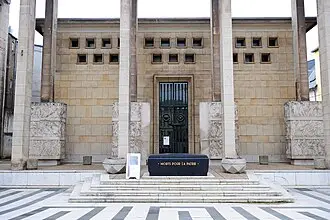
The National Museum of Resistance and Human Rights (Luxembourgish: Nationale Resistenzmusée; French: Musée National de la Résistance et des Droits Humains; German: Nationales Museum des Widerstands und der Menschenrechte) is located in the centre of Esch-sur-Alzette in the south-
- National Mining Museum, Luxembourg
The National Mining Museum (French: Musée National des Mines) of Luxembourg is located in the very south of the country, in Rumelange, which is close to the French border. The museum opened in 1973, at the site of the Walert mine. It provides an on-site exhibition of the tools, m
- Mosconi (restaurant)
Mosconi is an Italian restaurant located at 13 rue Munster in the Grund district of Luxembourg City, Luxembourg, overlooking the river Alzette. Headed by Italian chef Ilario Mosconi, it is one of the Relais & Châteaux series of hotels and gourmet restaurants from around the world
- Pfaffenthal-Kirchberg funicular
The Pfaffenthal-Kirchberg funicular is an automated funicular in Luxembourg City. The line links Pfaffenthal-Kirchberg railway station, on Société Nationale des Chemins de Fer Luxembourgeois (CFL) Line 10, to Rout Bréck – Pafendall tram stop, on Luxtram, near the European Investm
- Le Juste Milieu Mosque
Le Juste Milieu (from Arabic: الوسط, romanized: al-waṣaṭ, "the middle") is the name of an Islamic association and the first Islamic center in Bonnevoie, Luxembourg City. Luxembourg. The center's construction was largely funded by Qatar Charity. Qatar Charity and Le Juste Milieu w
- Palais de la Cour de Justice
The Palais de la Cour de Justice is a building complex acting as the seat of the Court of Justice of the European Union (CJEU), located in the Luxembourg City district of Kirchberg. Today the Palais complex encompasses the original 1973 building, now known as the Ancien Palais, w
- Hollerich
Hollerich (German pronunciation: [ˈhɔləʁɪç]; Luxembourgish: Hollerech, pronounced [ˈholəʀəɕ] ) is a district in south-western Luxembourg City, in southern Luxembourg. As of 31 December 2025, the district has a population of 7,751 inhabitants. Hollerich railway station is located
- Differdange Castle
Differdange Castle (Luxembourgish: Schlass Déifferdeng; French: Château de Differdange; German: Schloss Differdingen) is a Renaissance-era château located on a hill in the centre of Differdange in southern Luxembourg. It was built in 1577, although an earlier fortified castle of
- Lameschmillen
Lameschmillen, also known as the Bergemer Mühle, is located halfway between Bergem and Noertzange (Commune of Mondercange), at the confluence of the rivers Alzette and Mess. It is one of three watermills in Luxembourg with the same name. It marks the southern limit of the Dumonts
- Heisdorf Castle
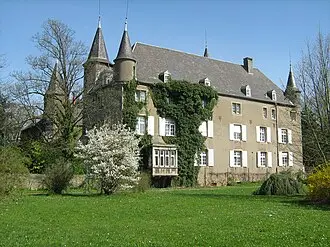
Heisdorf Castle (Luxembourgish: Schlass Heeschdref; French: Château de Heisdorf; German: Schloss Heisdorf) located in the village of Heisdorf in central Luxembourg was built by Baron Lippmann in the late 19th century. Surrounded by a large park, it was designed by the Belgian arc
- Conservatoire de Luxembourg
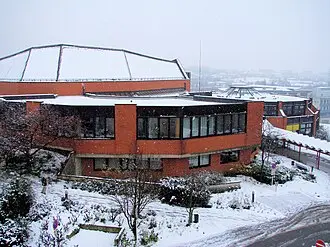
The Conservatoire de Luxembourg is a music school in Luxembourg City, in southern Luxembourg. The conservatoire was founded in 1906, and teaches dance, music and drama to approximately 3,800 students. It is housed in a purpose-built building opened in 1984. The grand hall's Weste
- Athus
Athus (German: Athem, Luxembourgish: Attem, Walloon: Atu) is a part of Aubange city Wallonia and a district of the municipality of Aubange, located in the province of Luxembourg, Belgium. It is located in the far south of the country, just near the borders with France and Luxembo
- Bettembourg Castle
Bettembourg Castle (Luxembourgish: Schlass Beetebuerg; French: Château de Bettembourg) located in the centre of Bettembourg in the south of Luxembourg has a history starting in 1733 when it was built as the residence of a farming family. Today it houses the offices and services o
- Notre-Dame Cathedral, Luxembourg
Notre Dame Cathedral (Luxembourgish: Kathedral Notre Dame, French: Cathédrale Notre-Dame, German: Kathedrale unserer lieben Frau) is the Catholic cathedral of the Archdiocese of Luxembourg, located in Luxembourg City in southern Luxembourg. It was originally a Jesuit church, and
- CRP Henri Tudor
The Public Research Centre Henri Tudor (or CRP Henri Tudor) is a Luxembourg-based research institute. Created in late 1987, in the framework of the Luxembourgish law of 9 March 1987 about public research, the CRP Henri Tudor took its name from Henri Owen Tudor, a famous Luxembour
- National Audiovisual Centre
The National Audiovisual Centre (French: Centre national de l'audiovisuel or CNA) was created in 1989 and is based in Dudelange, Luxembourg. Its function is to safeguard and promote Luxembourgish audiovisual art. More specifically, it is concerned with photographic, audio and fil
- Pétrusse
The Pétrusse (French pronunciation: [petʁys]; Luxembourgish: Péitruss [ˈpɜɪ̯tʀus] ; German: Petruss) is a river flowing through Luxembourg, joining the Alzette at Luxembourg City. It flows through the town of Hollerich, and is 11 kilometres (6.8 mi) long and 50 metres (160 ft) d
- Pfaffenthal Panoramic Elevator
The Pfaffenthal Panoramic Elevator (Luxembourgish: Lift Pafendall-Uewerstad; French: Ascenseur panoramique Pfaffenthal - Ville-Haute; German: Aufzug Pfaffenthal-Oberstadt) is a public elevator in Luxembourg City, Luxembourg which connects the city districts of Ville Haute, the hi
- Villa Pauly
The Villa Pauly was built in 1923 at No. 57, Boulevard de la Pétrusse, in the center of Luxembourg, for the surgeon Dr. Norbert Pauly; the architect was Mathias Martin. With its corner towers, the house mimics the castle architecture of the Late Middle Ages and the Renaissance. I
- La Fontaine Castle
La Fontaine Castle (French: Château La Fontaine, German: Schloss La Fontaine Luxembourgish: Schlass La Fontaine) was a castle in Clausen, Luxembourg. The elaborate building was the residence of Peter Ernst I von Mansfeld-Vorderort, governor of Luxembourg, who began its constructi
- Photothèque (Luxembourg)
The Photothèque (officially Photothèque de la Ville de Luxembourg) in Luxembourg City in the Grand Duchy of Luxembourg houses several large collections of photographs of the city taken between 1855 and today. Open to the public, it is modelled on the photothèque at the Centre Geo
- Sanem Castle
Sanem Castle (French: Château de Sanem, Luxembourgish: Schlass Suessem), located in the village of Sanem near Esch-sur-Alzette in south-western Luxembourg has a history dating back to the 13th century. Today's building was completed in 1557 after the medieval castle had been part
- Lallange
Lallange (Luxembourgish: Lalleng) is a quarter in the north-east of Esch-sur-Alzette, in south-western Luxembourg. It was integrated into the city in 1906, and was developed mostly starting in the 1950s, as terrain was freed when the Esch-sur-Alzette aerodrome – the first in Luxe
Museums, religious and historic sites, nature — with photos, descriptions and directions








By continuing to use the Platform, you agree to cookies and similar technologies. If you do not agree, discontinue use.
VIDI Privacy Policy
·
VIDI Cookie Policy
By continuing to use the Platform, you agree to cookies and similar technologies. If you do not agree, discontinue use.
VIDI Privacy Policy
·
VIDI Cookie Policy