- Jaffa
- Nazareth
- Haifa
- West Jerusalem
- Bat Yam
- Jerusalem
- Bet Shemesh
- Beersheba
- Rishon LeTsiyyon
- Modiin Ilit
- Ashdod
- Bnei Brak
- Qiryat Ata
- Ness Ziona
- Tel Aviv
- Ramat Gan
- Petaẖ Tiqva
- Netanya
- Kiryat Gat
- Nahariyya
- Eilat
- Reẖovot
- Ashkelon
- Mitzpe Ramon
- Assyrian siege of Jerusalem
The Assyrian siege of Jerusalem (c. 701 BC) was an aborted siege of Jerusalem, then capital of the Kingdom of Judah, carried out by Sennacherib, king of the Neo-Assyrian Empire. The siege concluded Sennacharib's campaign in the Levant, in which he attacked the fortified cities an
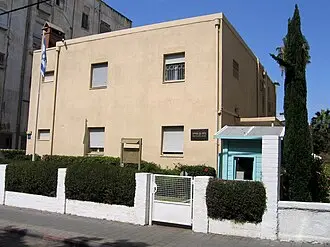
- Ben-Gurion House
The Ben-Gurion House is a historic house museum in Tel Aviv, which served as the family home of pre-State Zionist leader and then first Defense and Prime Minister of Israel, David Ben-Gurion, between 1931 and 1953. Until his death in 1973, it continued serving as an additional re
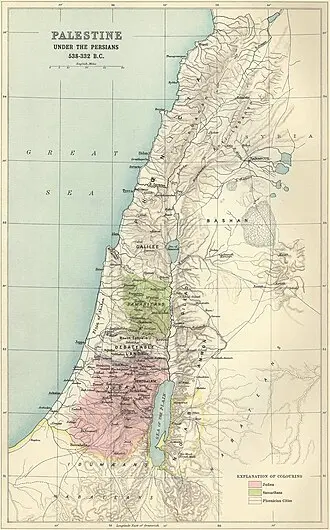
- Yehud (Persian province)
Yehud or Yehud Medinta (Biblical Aramaic: יְהוּד מְדִינְתָּא, Yəhūḏ Məḏīntā, "the province of Judah"), sometimes misread as Yehud Medinata, was an autonomous province of the Achaemenid Empire. The name is originally Aramaic and was first introduced after Judah fell to the Babylon
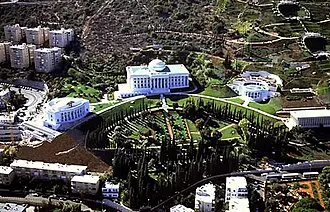
- Baháʼí World Centre buildings
The Baháʼí World Centre buildings are buildings that are part of the Baháʼí World Centre in Israel. The Baháʼí World Centre buildings include both the Baháʼí holy places used for pilgrimage and the international administrative bodies of the Baháʼí Faith; they comprise more than 2
- Bayt Dajan
Bayt Dajan (Arabic: بيت دجن, romanized: Bayt Dajan; Hebrew: בית דג'ן), also known as Dajūn, was a Palestinian Arab village situated approximately 6 kilometers (3.7 mi) southeast of Jaffa. It is thought to have been the site of the biblical town of Beth Dagon, mentioned in the Boo
- Antipatris
Antipatris (Hebrew: אנטיפטריס, Ancient Greek: Ἀντιπατρίς) was a city built during the first century BC by Herod the Great, who named it in honour of his father, Antipater. The site, now a national park in central Israel, was inhabited from the Chalcolithic period to the Late Rom
- Nahal Alexander
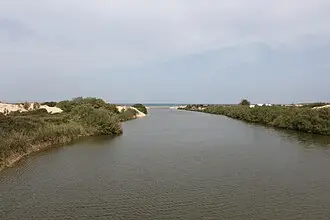
Nahal Alexander and Wadi Zeimar are the names of a river in Israel that flows from the western side of the Samaria mountain belt in the West Bank to the Mediterranean Sea north of Netanya, mostly through the Hefer Valley. Nahal Alexander (Hebrew: נחל אלכסנדר, romanized: Alexander
- Ashdod-Yam
Ashdod-Yam (Greek: Άζωτος παράλιος, romanized: Azotus Paralios, lit. 'Ashdod on the Sea') is an ancient port city on the Mediterranean coast of Israel, located in the southern part of the modern city of Ashdod, and about 5 kilometres northwest of the ancient site of Tel Ashdod, w
- Tel Zeton
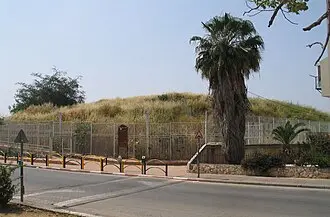
Tel Zeton (Hebrew: תל זיתון, also known as Tell Abu Zeitun, is an archaeological site in the Pardes Katz neighborhood of Bnei Brak, Israel. It lies 800 m (2,600 ft) south of the Yarkon River. The mound rises to a height of 9 m (30 ft) above its surroundings and spans an area of 2
- Battle of Beersheba (1917)
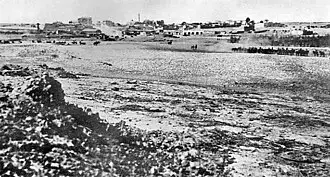
The Battle of Beersheba (Turkish: Birüssebi Muharebesi, German: Schlacht von Beerscheba) was fought on 31 October 1917, when the British Empire's Egyptian Expeditionary Force (EEF) attacked and captured the Ottoman Empire's Yildirim Army Group garrison at Beersheba, beginning the
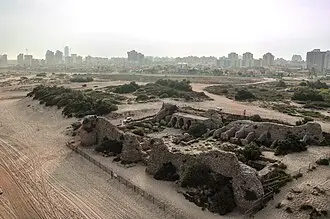
- Tel Gerisa
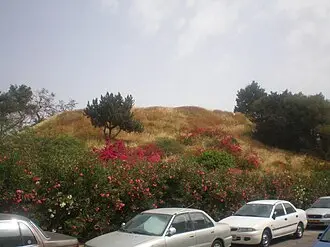
Tel Gerisa (Hebrew: תל גריסה) or Tell Jerishe and Tell Jarisha (Arabic), commonly known as Tel Napoleon (Hebrew: תל נפוליאון, lit. 'Napoleon's Hill'), as his army camped on it during the siege of Jaffa, is an archaeological site in Tel Aviv, Israel, on the southern bank of the Ya
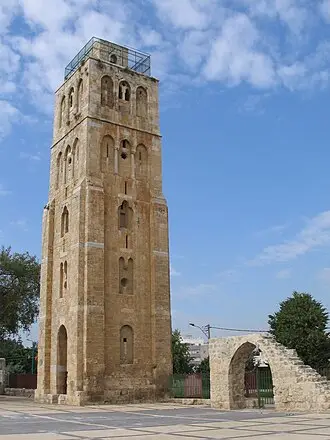
- White Mosque of Ramle
The White Mosque (Arabic: المسجد الأبيض, romanized: al-Masjid al-Abyad; Hebrew: המסגד הלבן, romanized: HaMisgad HaLavan) was an Umayyad-era mosque, now in partial ruins, located in Ramle, in central Israel. Only its minaret is still standing. According to local Islamic tradition,
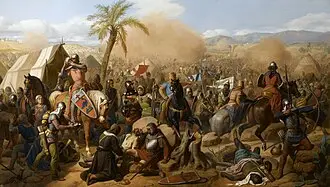
- Battle of Ascalon
The Battle of Ascalon took place on 12 August 1099 shortly after the capture of Jerusalem. Often considered the last action of the First Crusade, the Crusader army led by Godfrey of Bouillon defeated and drove off a Fatimid army of Egypt. The Crusaders completed their primary obj
- Murder of Helena Rapp
The murder of Helena Rapp occurred on 24 May 1992 when a Palestinian stabbed 15-year-old Israeli Helena Rapp to death in the Israeli coastal city of Bat Yam. The attack shocked the Israeli public as one of the more prominent of a series of stabbing attacks that took place in Isra
- Khirbet Qeiyafa
Khirbet Qeiyafa (Arabic: خِرْبَة قِيَافَة, romanized: Khirbat Qiyāfa), also known as Elah Fortress and in Hebrew as Horbat Qayafa (Hebrew: חוֹרְבָת קַייָאפַה), is the site of an ancient fortress city overlooking the Valley of Elah and dated to the first half of the 10th century B
- Battle of Jaffa (1192)
The Battle of Jaffa took place during the Crusades, as one of a series of campaigns between the army of Sultan Saladin (Ṣalāḥ al-Dīn Yūsuf ibn Ayyūb) and the Crusader forces led by King Richard I of England (known as Richard the Lionheart). It was the final battle of the Third Cr
- Sepphoris
Sepphoris ( sef-OR-iss; Ancient Greek: Σεπφωρίς, romanized: Sepphōris), known in Hebrew as Zippori/Tzipori (צִפּוֹרִי Ṣīppōrī) and in Arabic as Saffuriya (صفورية Ṣaffūriya), is one of the most excavated and studied archaeological sites in Israel. Over time, the site was home to
- Modi'in Illit
Modi'in Illit (Hebrew: מוֹדִיעִין עִלִּית, lit. 'Upper Modi'in'; Arabic: موديعين عيليت) is a Haredi Jewish-Israeli settlement organized as a city council in the West Bank, situated midway between Jerusalem and Tel Aviv. Built on the land of five Palestinian villages–Ni'lin, Kharb
- Tel Lachish
Lachish (Hebrew: לכיש, romanized: Lāḵîš; Koine Greek: Λαχίς; Latin: Lachis) was an ancient Canaanite and later Israelite city in the Shephelah ("lowlands") region of Canaan on the south bank of the Lakhish River. The current tell by that name, known as Tel Lachish (Hebrew: תל לכי
- Hawsha
Hawsha (Arabic: هوشة, Hǔsheh, also Husha, or Hosha), was an Arab village established in 1880 by Maghrebi immigrants of Algerian origin, built on ruins of the ancient Jewish town Usha. The place is located 13 kilometers (8.1 mi) east of Haifa, about 100 meters (330 ft) above sea l
- Shrine of Baháʼu'lláh
The Shrine of Baháʼu'lláh (Persian: آرامگاه حضرت بهاءاللّٰه, romanized: Ārāmgāh-i-Ḥaḍrat-i-Baháʼu'lláh; Arabic: مقام حضرة بهاء الله, romanized: Maqám Ḥaḍrat Baháʼu'lláh), known among Baháʼís as the Blessed Shrine (Persian: روضۀ مبارکه, romanized: Rawḍa-yi-Mubáraka), is the burial
- Aqaba Fortress
The Aqaba Castle or Aqaba Fort (Arabic: قلعة العقبة, romanized: Qalʿat al-ʿAqaba), also known as the Mamluk Castle of Aqaba, Jordan, is a Mamluk and Ottoman fortified caravanserai on the pilgrimage route to Mecca and Medina which, in its current form, dates back mainly to the 16t
- Ramla
Ramla (Hebrew: רַמְלָה, romanized: Ramla), also known as Ramle (Arabic: الرملة, romanized: ar-Ramla, Palestinian Arabic: [ɪrˈrɑmle]), is a city in the Central District of Israel. Ramle is one of Israel's mixed cities, with significant numbers of both Jews and Arab citizens of Isr
- Makhtesh Ramon
Makhtesh Ramon (Hebrew: מכתש רמון; lit. Ramon Crater/Makhtesh; Arabic: وادي الرمان; lit. The Ruman Wadi) is a geological feature of Israel's Negev desert. Located some 85 km south of Beersheba, the landform is the world's largest "erosion cirque" (steephead valley or box canyon).





By continuing to use the Platform, you agree to cookies and similar technologies. If you do not agree, discontinue use.
VIDI Privacy Policy
·
VIDI Cookie Policy
By continuing to use the Platform, you agree to cookies and similar technologies. If you do not agree, discontinue use.
VIDI Privacy Policy
·
VIDI Cookie Policy