- Abū an Numrus
- Giza
- Luxor
- Cairo
- Alexandria
- Ḩadā’iq al Qubbah
- Madīnat an Naşr
- Al Khuşūş
- Aswān
- Būlāq Abū al ‘Ilā
- Al Ḩawāmidīyah
- Al Badrashayn
- Shubrā al Khaymah
- Ḩalwān
- Suez
- Az-Zuhūr
- Aḍ-Ḍawāḥy
- Al-Manākh
- Būr Fu’ād
- Port Said
- Qalyub
- Qina
- Armant
- Al Maḩallah al Kubrá
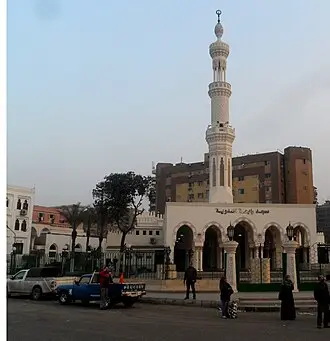
- Al-Hakim Mosque
The al-Hakim Mosque (Arabic: مسجد الحاكم, romanized: Masjid al-Ḥākim), also known as al-Anwar (Arabic: الانور, lit. 'the Illuminated'), is a mosque in Cairo, Egypt. It is named after al-Ḥākim bi-Amr Allāh (985–1021), the 6th Fatimid caliph and 16th Ismāʿīlī Imam. Construction of
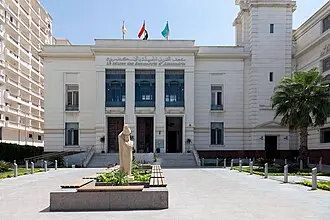
- Alexandria Museum of Fine Arts
The Alexandria Museum of Fine Arts is a museum for Egyptian and Middle-Eastern fine art in Alexandria, Egypt. Located in the Moharam Bek neighborhood, it houses a collection of works by Egyptian artist and a selection of works from Baroque, Romanticism, Rococo and Orientalism. In
- Manial Palace and Museum
The Manial Palace and Museum is a former Alawiyya dynasty era palace and grounds on Rhoda Island on the Nile. It is of Ottoman architecture and located in the Sharia Al-Saray area in the El-Manial district of southern Cairo, Egypt. The palace and estate has been preserved as an A
- Theodor Bilharz Research Institute
The Theodor Bilharz Research Institute is located in Giza, Egypt. Theodor Bilharz was a German scientist who discovered, in autopsy material at Kasr El Aini Hospital, the causative agent of haematuria: Schistosoma worm, during his work in Egypt in 1851. The bilhariziasis disease
- Port Said Lighthouse
Port Said Lighthouse (Arabic: فنار بورسعيد القديم) is one of the most important architectural and tourist landmarks in the city of Port Said in Egypt. Considered a unique example for the evolution of architecture during the nineteenth century in the city, the lighthouse was desig
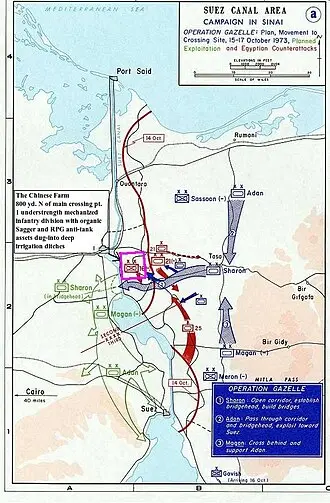
- Battle of Suez
The Battle of Suez was fought on October 24–25, 1973 between the Israel Defense Forces and the Egyptian Army in the Egyptian city of Suez. It was the closing battle of the Yom Kippur War, before a ceasefire took effect. On October 23, with the imminent arrival of UN observers to
- Rabaa al-Adawiya Mosque
The Rabaa al-Adawiya Mosque (Arabic: مسجد رابعة العدوية, Egyptian Arabic: [ˈɾɑbʕɑ l.ʕædæˈwejjæ]), also transliterated Rabi'a al-Adawiya, Rabaa el-Adawia or Rabaa el-Adaweya, is a mosque located on the northern edge of Nasr City district in eastern Cairo, Egypt. Completed in the c
- Chemins de fer de la Basse-Egypte
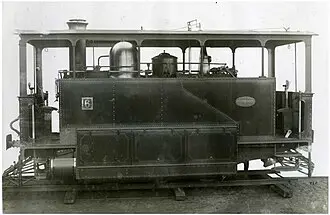
The Chemins de fer de la Basse-Egypte built and operated a network of up to seven lines of metre-gauge (1,000 mm, 3 ft 3+3⁄8 in) railway track in the area around Mansourah in Egypt.
- Nile Delta
The Nile Delta (Arabic: دلتا النيل, Delta an-Nīl or simply الدلتا, ad-Delta) is the delta formed in Lower Egypt where the Nile River spreads out and drains into the Mediterranean Sea. It is one of the world's largest deltas. From Alexandria in the west to Port Said in the east; i
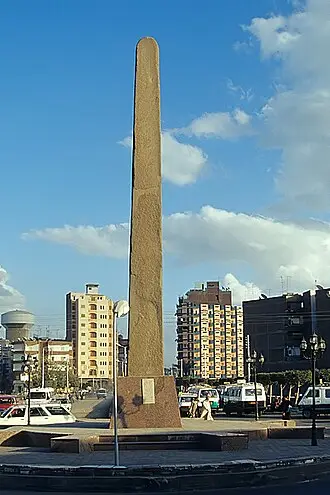
- Abgig obelisk
The Abgig obelisk (also known as the Begig obelisk and the Faiyum obelisk) is an ancient stone monument erected by the Egyptian king Senusret I in the 20th century BC near what is now Faiyum. Made of red granite, it is likely that the obelisk once stood 12.9 metres (42.3 ft) high
- Heliopolis (ancient Egypt)
Heliopolis (Jwnw, Iunu; Ancient Egyptian: 𓉺𓏌𓊖, romanized: jwnw, lit. 'the Pillars'; Coptic: ⲱⲛ, Biblical Hebrew: אֹן, romanized: ʾOn; Greek: Ἡλιούπολις, romanized: Hēlioúpolis, lit. 'City of the Sun') was a major city of ancient Egypt. It was the capital of the Heliopolite or
- Temple of Esna
The Temple of Esna, also known as the Temple of Khnum at Esna, is an ancient Egyptian temple in the city of Esna, about 64 kilometres south of Luxor. The temple was mainly dedicated to the creator god Khnum and the goddess Neith. Other deities worshipped there included Heka, Menh
- Bubastis
Bubastis (Bohairic Coptic: Ⲡⲟⲩⲃⲁⲥϯ Poubasti; Greek: Βούβαστις Boubastis or Βούβαστος Boubastos), also known in Arabic as Tell-Basta or in Egyptian as Per-Bast, was an ancient Egyptian city. Bubastis is often identified with the biblical Pi-Beseth (Hebrew: פי-בסת py-bst, Ezekiel 3
- Lake Timsah
Lake Timsah, Arabic for Crocodile Lake (Arabic: بُحَيْرة التِّمْسَاح), is a lake in Egypt on the Nile Delta. It lies in a basin developed along a fault extending from the Mediterranean Sea to the Gulf of Suez through the Bitter Lakes region. In 1800, a flood filled the Wadi Tumil
- Medinet Habu
Medinet Habu (Arabic: مدينة هابو, romanized: Madīnat Hābū; Ancient Egyptian: ḏ3mwt; Sahidic Coptic: (ⲧ)ϫⲏⲙⲉ, ⲉϫⲏⲙⲉ, ϫⲏⲙⲏ, ϫⲉⲙⲉ, ϫⲉⲙⲏ, ϫⲏⲙⲓ; Bohairic Coptic: ϭⲏⲙⲓ) is an archaeological locality situated near the foot of the Theban Hills on the West Bank of the River Nile opposite
- Temple of Kom Ombo
The Temple of Kom Ombo is an unusual double temple in the town of Kom Ombo in Aswan Governorate, Upper Egypt. It was constructed during the Ptolemaic dynasty, 180–47 BC. Some additions to it were later made during the Roman period. In ancient times, Kom Ombo was called NBU, meani
- Philae temple complex
The Philae temple complex (; Ancient Greek: Φιλαί or Φιλή and Πιλάχ, Arabic: فيلة Egyptian Arabic: [fiːlæ], Egyptian: p3-jw-rķ' or 'pA-jw-rq; Coptic: ⲡⲓⲗⲁⲕ, ⲡⲓⲗⲁⲕϩ, Coptic pronunciation: [ˈpilɑk, ˈpilɑkh]) is an island-based temple complex in the reservoir of the Aswan Low Dam,
- Saint Mark's Coptic Orthodox Cathedral
Saint Mark's Coptic Orthodox Cathedral (Arabic: كاتدرائية القديس مرقس القبطية الأرثوذكسية, romanized: Kātidrāʼīyat al-Qiddīs Murqus al-Qibṭīyah al-Urthūdhuksīyah) is a Coptic church located in the Abbassia District in Cairo, Egypt. The cathedral is the seat of the Coptic Orthodox
- Amr ibn al-As Mosque (Damietta)
The Amr ibn al-As Mosque (Arabic: مَسْجِد عَمْرِو بْنِ الْعَاصِ, romanized: Masjid ʿAmr ibn al-ʿĀṣ), also known as the Abu'l-Ma'ati Mosque, and as the Al-Fateh Mosque, is a mosque in Damietta, Egypt. According to some local sources, it is the second mosque built in Egypt, named f
- Fort Julien
Fort Julien (or, in some sources, Fort Rashid ) (Arabic: طابية رشيد) is a fort located on the left or west bank of the Nile about 5 kilometres (3.1 mi) north-west of Rashid (Rosetta) on the north coast of Egypt. It was originally built by the Mamluks and occupied by the French du
- Red Monastery
The Red Monastery (Arabic: الدير الاحمر) or The Monastery of Apa Pshay (Coptic: ⲡⲙⲟⲛⲁⲥⲧⲏⲣⲓⲟⲛ ⲛ̀ⲧⲉ ⲁⲡⲁ ⲡⲯⲟⲓ) is a Coptic Orthodox monastery named after an Egyptian saint named Pshay (Coptic: ⲯⲟⲓ) or Pishay (Coptic: ⲡⲓϣⲱⲓ), not to be confused with Pishoy, Bishop of Sketis (now the
- Dendera light
The so-called "Dendera light" is a motif in the Hathor temple at Dendera in Egypt. According to the hieroglyphic text surrounding the pieces, it depicts statues referencing part of an Egyptian creation myth. The temple, especially its crypts, contain several reliefs depicting sta
- Helwan
Helwan (Arabic: حلوان Ḥelwān, IPA: [ħelˈwæːn], Coptic: ϩⲁⲗⲟⲩⲁⲛ, romanized: Halwan) is a suburban district in the southern part of Cairo, Egypt, directly opposite the ruins of Memphis. The area of Helwan witnessed prehistoric, ancient Egyptian, Roman and Muslim era activity, and i
- Saint Shenouda Coptic Orthodox Church
Saint Shenouda Coptic Orthodox Cathedral is a Coptic church located in the El Dahar neighborhood of Hurghada, Egypt. The church is dedicated to Saint Shenouda.







By continuing to use the Platform, you agree to cookies and similar technologies. If you do not agree, discontinue use.
VIDI Privacy Policy
·
VIDI Cookie Policy
By continuing to use the Platform, you agree to cookies and similar technologies. If you do not agree, discontinue use.
VIDI Privacy Policy
·
VIDI Cookie Policy