- Split
- Osijek
- Dubrovnik
- Pula
- Centar
- Zagreb
- Rijeka
- Šibenik
- Zadar
- Velika Gorica
- Sesvete
- Karlovac
- Omišalj
- Sisak
- Hvar
- Rovinj
- Artatore
- Gornji Humac
- Slavonski Brod
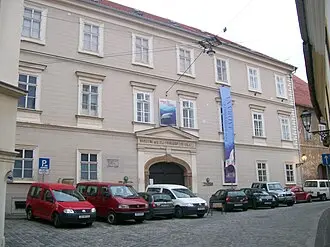
- Croatian Natural History Museum
The Croatian Natural History Museum (Croatian: Hrvatski prirodoslovni muzej) is the oldest and biggest natural history museum and the main body for natural history research, preservation and collection in Croatia. Located on Dimitrije Demeter Street in Gornji Grad, one of the old
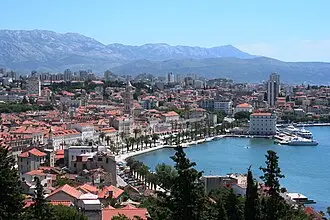
- Split, Croatia
Split (; Croatian: [splît] ) is the second-largest city in Croatia, after the capital Zagreb, situated on the eastern shore of the Adriatic Sea. As the administrative seat of Split-Dalmatia County and the largest city on the Croatian coast, it serves as a key economic, cultural,
- Rječina
The Rječina (Italian: Eneo; German: Flaum or Pflaum), also known as the Fiumara, is a river in Croatia that flows into the Adriatic Sea at the city of Rijeka (Italian: Fiume). It is about 18 kilometers (11 mi) long, with an average width of 9 to 16 meters (30 to 52 ft). It spring
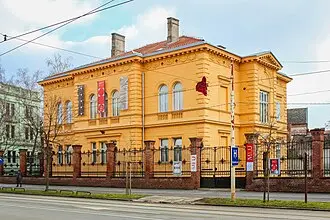
- Museum of Fine Arts, Osijek
The Museum of Fine Arts (Croatian: Muzej likovnih umjetnosti) is an art museum in Osijek, Croatia. It was established in 1954. The Museum of Fine Arts in Osijek collects, preserves, researches and presents artistic heritage ranging from the Baroque to recent art. The Museum's hol
- Chest of Saint Simeon
The Chest of Saint Simeon or Saint Simeon's Casket (Croatian: Škrinja sv. Šimuna) is a rectangular cedarwood sarcophagus in the shape of a chasse, overlaid with silver and silver-gilt plaques, said to hold the relics of St Simon the God-receiver; it is located over the main altar
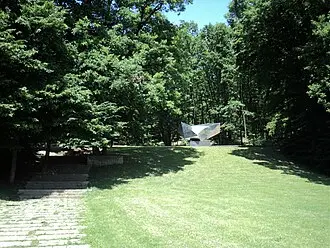
- Dotrščina
Dotrščina is a forest park in the northeast of Zagreb, Croatia. It is a protected area as a historical site of mass executions in World War II. It is located north of the Maksimir forest park and south of the Medvednica mountain, and includes 365 cadastral acres (approx. 2 km2),
- Raid on Pula
The raid on Pula was an Italian Navy operation conducted during the night of 31 October – 1 November 1918, at the end of World War I. It was carried out by frogmen Lieutenant Colonel Raffaele Rossetti and Raffaele Paolucci, who used the Mignatta human torpedo to sink the former f
- Brod, Bosnia and Herzegovina
Brod (Serbian Cyrillic: Брод, pronounced [brôːd]), formerly Bosanski Brod (Serbian Cyrillic: Босански Брод) and Srpski Brod (Serbian Cyrillic: Српски Брод), is a town and municipality in Republika Srpska, Bosnia and Herzegovina. It is situated on the south bank of the river Sava,
- Karlovac County
Karlovac County (Croatian: Karlovačka županija) is a county in central Croatia, with the administrative center in Karlovac. It borders Bosnia and Herzegovina and Slovenia. The city of Karlovac is a fort from the times of the Military Frontier with the Ottoman Empire. It was built
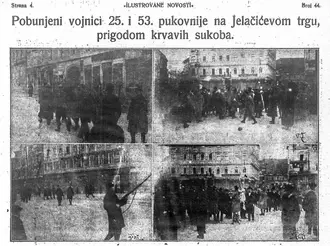
- 1918 protest in Zagreb
On 5 December 1918, four days after the proclamation of the Kingdom of Serbs, Croats and Slovenes, the National Guards (an armed force of the National Council of the State of Slovenes, Croats and Serbs) and Sokol volunteers suppressed a protest and engaged in an armed clash again
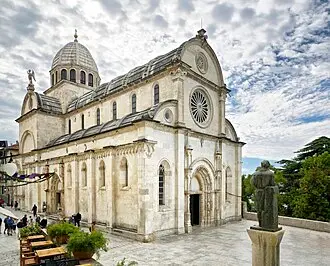
- Šibenik Cathedral
The Cathedral of St. James (Croatian: Katedrala sv. Jakova) or simply Šibenik Cathedral is a triple-nave Catholic cathedral with three apses and a dome (32 m high inside) in Šibenik, Croatia. It is the episcopal seat of the Diocese of Šibenik. It is often known as "St. Jacob's",
- Church of St. George and the Name of Mary, Zagreb
St. George Church and Name of Mary (Croatian: Župna crkva sv. Jurja mučenika i Imena Marijina u Odri) is a Catholic parish church located in the neighbourhood Odra of Zagreb, Croatia. The church was built gradually from 1749 to 1780.
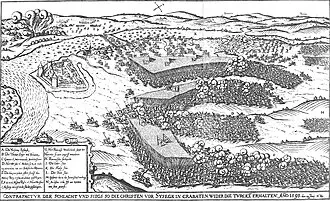
- Battle of Sisak
The Battle of Sisak was fought on 22 June 1593 between Ottoman Bosnian forces and a combined Christian army from the Habsburg lands, mainly the Kingdom of Croatia and Inner Austria. The battle took place at Sisak, central Croatia, at the confluence of the Sava and Kupa rivers, on
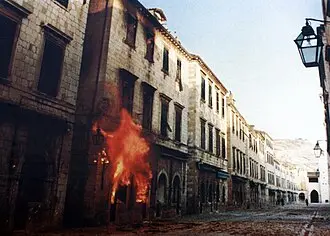
- Siege of Dubrovnik
The siege of Dubrovnik (Serbo-Croatian: opsada Dubrovnika, опсада Дубровника) was a military campaign fought between the Yugoslav People's Army (JNA) and Croatian forces defending the city of Dubrovnik and its surroundings during the Croatian War of Independence. The JNA started
- Vrsar
Vrsar (Italian and Venetian: Orsera) is a seaside village and a municipality in Istria, west Croatia, located 9 kilometers south of Poreč. The historical center is located on top of a hill, including the St. Martin parish church and the 40-meter high bell tower. In the 20th centu
- Hvar Arsenal
The Hvar Arsenal is a historic building in the town of Hvar, Croatia. It was first constructed in the 14th century as a maintenance shipyard for the galley of the commune. Over time it was further expanded and gained additional functions. Most notable is the historic theater (Hva
- Haludovo Palace Hotel
The Haludovo Palace Hotel is an abandoned resort hotel near Malinska on the island of Krk, Croatia. It formed the architectural and social centre of Haludovo, a large tourist resort designed by Croatian architect Boris Magaš and constructed between 1969 and 1972 during the rapid
- Pučišća
Pučišća (Croatian pronunciation: [pûtʃiːʃt͡ɕa]) is a coastal town and a municipality on the island of Brač in Croatia. It is often listed as one of the prettiest villages in Europe. It is known for its white limestone and beautiful bay. The town has a population of 1,351 (2021 ce
- Veli Lošinj
Veli Lošinj (Italian: Lussingrande) is a village on the island of Lošinj in Primorje-Gorski Kotar County in western Croatia. Veli Lošinj has a mild climate and caters to tourists. It is located 5 km to the southeast of the town of Mali Lošinj, of which it is part administratively
- Medveščak (stream)
Medveščak (pronounced [medʋeʃtʃǎːk], also called Crikvenik) is a creek in central Zagreb, Croatia. It flows from Kraljičin zdenac in Podsljeme down along the southern slopes of the Medvednica mountain to the Manduševac Fountain, its mouth. The creek was covered in 1898 and today
- Salon Galić
Salon Galić is Split's oldest exhibition space, located in the heart of the town on Marmont Street 3. It was founded by Hrvace-born artisan Ivan Galić in May 1924 and was the only art gallery in Split during the interbellum. In the aforementioned period, the gallery hosted exhibi
- Archdiocese of Rijeka
The Metropolitan Archdiocese of Rijeka (Latin: Archidioecesis Metropolitae Fluminensis; Croatian: Riječka nadbiskupija i Metropolita) is a Latin Catholic Metropolitan archdiocese in Croatia. Its episcopal seat is Rijeka Cathedral, dedicated to Saint Vitus (Croatian: Katedrala Sv.
- Osijek Co-cathedral
The Church of St Peter and St Paul (Croatian: Crkva svetog Petra i Pavla), commonly referred to as the Osijek Co-cathedral (Croatian: Osječka konkatedrala), is a neo-Gothic co-cathedral of the Roman Catholic Archdiocese of Đakovo-Osijek, located in Osijek, Croatia. The multi-tier
- Siege of Zara
The siege of Zara or siege of Zadar (Croatian: opsada Zadra; Hungarian: Zára ostroma; 10–24 November 1202) was the first major action of the Fourth Crusade and the first attack against a Catholic city by Catholic crusaders. The crusaders had an agreement with Venice for transport








By continuing to use the Platform, you agree to cookies and similar technologies. If you do not agree, discontinue use.
VIDI Privacy Policy
·
VIDI Cookie Policy
By continuing to use the Platform, you agree to cookies and similar technologies. If you do not agree, discontinue use.
VIDI Privacy Policy
·
VIDI Cookie Policy