- Rio de Janeiro
- Salvador
- São Paulo
- Belo Horizonte
- Brasília
- Manaus
- Fortaleza
- Florianópolis
- Carianos
- São José
- Palhoça
- Pátio do Colégio
Pátio do Colégio (in Portuguese School Yard, written in the archaic orthography Pateo do Collegio) is the name given to the historical Jesuit church and school in the city of São Paulo, Brazil. The name is also used to refer to the square in front of the church. The Pátio do Colé
- Fundação Getulio Vargas
Fundação Getulio Vargas (Getulio Vargas Foundation, often abbreviated as FGV) is a Brazilian higher education institution and think tank based in Rio de Janeiro. It was founded on December 20, 1944. The institution was created in the last days of the Estado Novo, as an independen
- Palácio da Liberdade
The Palácio da Liberdade (Portuguese for "Palace of Liberty") is a historic government palace and cultural venue in Belo Horizonte, Minas Gerais, Brazil. The building stands at the upper end of Praça da Liberdade, in the civic center designed after the state capital was moved fro
- Salvador, Bahia
Salvador (Brazilian Portuguese: [sawvaˈdoʁ], local pronunciation: [-ˈdo(h)], formerly known as Cidade do São Salvador da Bahia de Todos os Santos, literally "City of the Holy Savior of the Bay of All the Saints") is a Brazilian municipality and capital city of the state of Bahia.
- Cocó Park
The Cocó Ecological Park (Portuguese: Parque Ecológico do Cocó) is an area on the Rio Cocó that serves as a conservation area and state park. It is located in the city of Fortaleza, Ceará, Brazil, considered of great importance, both for the city, and for the biodiversity that is
- Manaus Brazil Temple
The Manaus Brazil Temple is a temple of the Church of Jesus Christ of Latter-day Saints in Manaus, Amazonas, Brazil. The intent to construct it was announced on May 23, 2007, by the church's First Presidency. It became the sixth in Brazil, and the 138th operating temple worldwide
- Monumental Axis
The Monumental Axis (Brazilian Portuguese: Eixo Monumental) is the central and main avenue in Brasília's city design. The avenue begins on the National Congress of Brazil building and is considered part of the DF-002 road. Its first section is known as "Ministries Esplanade" (Esp
- Santa Catarina Island
Santa Catarina Island (Portuguese: Ilha de Santa Catarina) is an island in the Brazilian state of Santa Catarina, located off the southern coast. It is home to the state capital, Florianópolis.
- Florianópolis
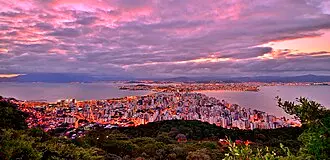
Florianópolis (English: FLOR-ee-ə-NOP-əl-iss, Brazilian Portuguese: [floɾiaˈnɔpolis]) is the capital and second largest city of the state of Santa Catarina, in the South Region of Brazil. The city encompasses Santa Catarina Island and surrounding small islands, as well as part o
- Vargem do Braço River
The Vargem do Braço River (Portuguese: Rio Vargem do Braço, also known as Rio Vargem do Cedro and Rio Pilões) is a river of the state of Santa Catarina, Brazil.
- Pirajubaé Marine Extractive Reserve
Pirajubaé Marine Extractive Reserve (Portuguese: Reserva Extrativista Marinha do Pirajubaé) is an extractive reserve in the state of Santa Catarina, Brazil, created in 1993. The purpose was to support sustainable harvesting of shellfish from a shoal in the south bay of the Santa
- Solar da Marquesa de Santos
The Solar da Marquesa de Santos is a manor house located in central São Paulo, Brazil, that hosts several cultural exhibitions and is currently the headquarters of the Cidade de São Paulo museum. The residence, made of rammed earth blocks, was built around the second half of the
- Museu Nacional de Belas Artes
The Museu Nacional de Belas Artes (MNBA; Portuguese for National Museum of Fine Arts) is a national art museum located in the city of Rio de Janeiro, Brazil. The museum, officially established in 1937 by the initiative of education minister Gustavo Capanema, was inaugurated in 19
- São José Church
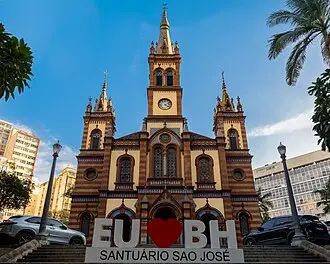
The São José Archdiocesan Sanctuary, commonly known as São José Church, is a Catholic church built in an eclectic style, with references to Gothic Revival and Neo-Manueline architecture. It is in the Centro neighborhood of Belo Horizonte, Minas Gerais. The church occupies elevate
- Colonial Brazil
Colonial Brazil (Portuguese: Brasil Colonial), sometimes referred to as Portuguese America, comprises the period from 1500, with the arrival of the Portuguese, until 1815, when Brazil was elevated to a kingdom in union with Portugal. During the 300 years of Brazilian colonial his
- St. Joseph's Cathedral, Fortaleza
The St. Joseph's Cathedral (Portuguese: Catedral Metropolitana de São José) also called Metropolitan Cathedral of St. Joseph is a Catholic church, home of the Archdiocese of Fortaleza, located in Fortaleza in Brazil. The present church was built on the site of the old church. It
- Amazon Theatre
The Amazon Theatre (Portuguese: Teatro Amazonas) is an opera house located in Manaus, Brazil. It is the location of the annual Festival Amazonas de Ópera (Amazonas Opera Festival) and the home of the Amazonas Philharmonic Orchestra which regularly rehearses and performs at the Am
- Clube do Choro de Brasília
The Clube de Choro de Brasília is an association dedicated to promoting and disseminating Choro. Located on the Monumental Axis, it is next to the Brasília Planetarium, and the Ulysses Guimarães Convention Center, whose cloakroom was transformed into the club's first headquarters
- Archdiocese of Florianópolis
The Archdiocese of Florianópolis (Latin: Archidioecesis Florianopolitanus) is an archdiocese located in the city of Florianópolis in Brazil.
- Palhoça
Palhoça is a municipality in eastern Santa Catarina, Brazil. It is located on the Atlantic coast, 17 km (10 mi) from the state’s capital, Florianópolis.
- Cubatão River (south Santa Catarina)
The Cubatão River is a river of Santa Catarina state in southeastern Brazil. The sources of the river are in the 84,130 hectares (207,900 acres) Serra do Tabuleiro State Park, a mountainous region to the south west of Florianópolis covered in lush rain forest. The river supplies
- Tavares River
The Tavares River or Rio Tavares is a river of Florianópolis, capital of Santa Catarina state in southeastern Brazil. Rio Tavares is also the name of a neighborhood in the city which is cut by the river.
- Church of the Wounds of the Seraphic Father Saint Francis
The Church of the Wounds of the Seraphic Father Saint Francis of the Venerable Third Order of Saint Francis of Penance of São Paulo (Portuguese: Igreja das Chagas do Seráfico Pai São Francisco da Venerável Ordem Terceira de São Francisco da Penitência de São Paulo), usually known
- Paço Imperial
The Paço Imperial (Brazilian Portuguese: [ˈpasu ĩpeɾiˈaw]), or Imperial Palace, previously known as the Royal Palace of Rio de Janeiro and Palace of the Viceroys, is a historic building in the center of the city of Rio de Janeiro, Brazil. The Paço Imperial was built in the 18th c





By continuing to use the Platform, you agree to cookies and similar technologies. If you do not agree, discontinue use.
VIDI Privacy Policy
·
VIDI Cookie Policy
By continuing to use the Platform, you agree to cookies and similar technologies. If you do not agree, discontinue use.
VIDI Privacy Policy
·
VIDI Cookie Policy