- Anderlecht
- Molenbeek-Saint-Jean
- Brussels
- Ixelles
- Saint-Gilles
- Antwerp
- Brugge
- Uccle
- Deurne
- Jette
- Gent
- Liège
- Leuven
- Mons
- Forest
- Mechelen
- Crotteux
- Woluwe-Saint-Lambert
- Hasselt
- Aalst
- Mariakerke - Raversijde
- Tournai
- Schaerbeek
- Charleroi
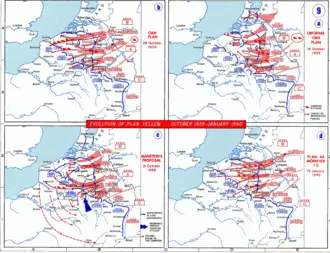
- Manstein plan
The Manstein plan was the war plan of the German armed forces (Wehrmacht) for the Battle of France in 1940. The original invasion plan was an awkward compromise devised by General Franz Halder, the chief of staff of Oberkommando des Heeres (OKH, Army High Command) that satisfied
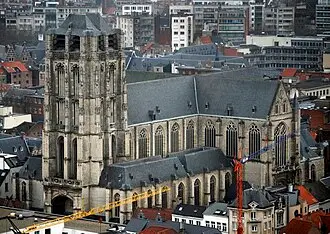
- St. James' Church, Antwerp
St. James' Church (Dutch: Sint-Jacobskerk) is a former collegiate church in Antwerp, Belgium. The church was built on the site of a hostel and chapel used by pilgrims to Santiago de Compostela and is still a pilgrimage church for those travelling to Santiago de Compostela. The bu
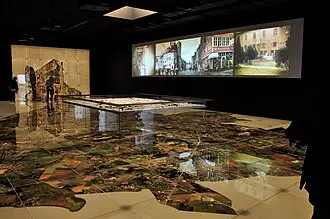
- Ghent City Museum
The Ghent City Museum (in Dutch "Stadsmuseum Gent", "STAM" in short) is a museum in the Belgian city of Ghent. The museum exposes the city history and opened its doors on 9 October 2010. With respect to the collection that is shown, the history of this museum goes back to 1833, t
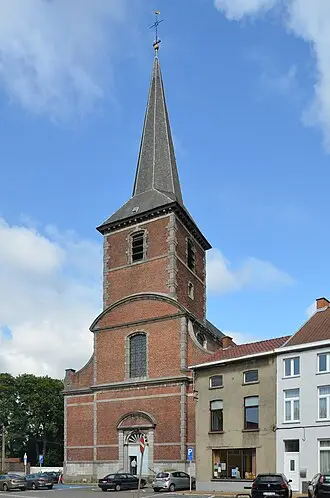
- Church of Saint-Sulpice, Jumet
The Church of Saint Sulpice (French: Église Saint-Sulpice; French pronunciation: [sɛ̃sylpis]) is a Catholic church in Jumet, a neighborhood of the Belgian city of Charleroi in Hainaut Province, Wallonia. It is dedicated to Sulpitius the Pious. The oldest material traces of a reli
- Tour Paradis
Tour Paradis (pronounced [tuʁ paʁadi], Paradise Tower), also known as Tour des Finances de Liège (French pronunciation: [tuʁ de finɑ̃s də ljɛʒ], Financial Tower of Liège), is a 136-metre office skyscraper located in the Guillemins area of Liège, Belgium. Designed by Jaspers-Eyers
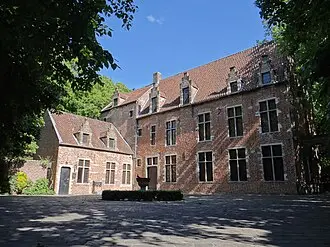
- Erasmus House
The Erasmus House (French: Maison d'Érasme; Dutch: Erasmushuis), also known as the Erasmus House Museum (French: Musée de la Maison d'Érasme; Dutch: Erasmushuismuseum), and formerly as the De Swaene chapter house, is a historic house museum in Anderlecht, a municipality of Brusse
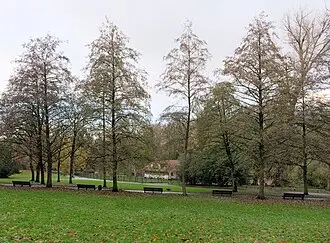
- Josaphat Park
Josaphat Park (French: Parc Josaphat, pronounced [paʁk ʒozafa]; Dutch: Josaphatpark, pronounced [ˈjoːsafa(t)ˌpɑr(ə)k]) is an urban public park of 20 ha (49 acres) in the municipality of Schaerbeek in Brussels, Belgium. The hilly English-style park was designed between 1901 and 19
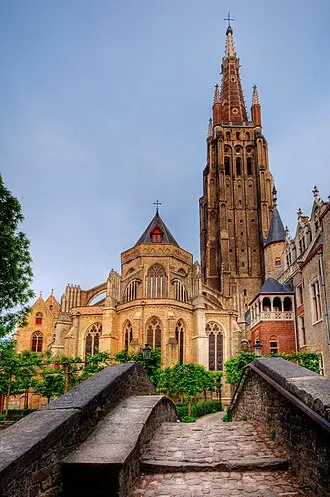
- Church of Our Lady, Bruges
The Church of Our Lady (Dutch: Onze-Lieve-Vrouwekerk) is a Roman Catholic church in Bruges, Belgium, dating mainly from the 13th, 14th and 15th centuries. Its 115.6-metre-high (379 ft) tower remains the tallest structure in the city and the third tallest brickwork church tower in
- Sambre
The Sambre (French: [sɑ̃bʁ]; Walloon: Sambe; Dutch: Samber ) is a river in northern France and in Wallonia, Belgium. It is a left-bank tributary of the Meuse, which it joins in the Wallonian capital Namur. The source of the Sambre is near Le Nouvion-en-Thiérache, in the Aisne dep
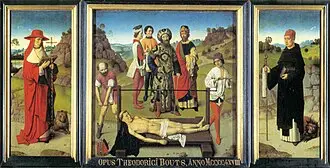
- The Martyrdom of Saint Erasmus (Bouts)
The Martyrdom of Saint Erasmus is a triptych panel painting by the Flemish painter Dieric Bouts in the collegiate church of Saint Peter's in Leuven, Belgium. It commemorates the martyrdom and death of a European Christian figure from the fourth century, Saint Erasmus. It shows th
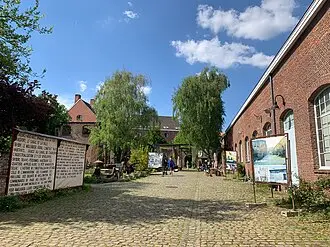
- La Fonderie, Brussels Museum of Industry and Labour
La Fonderie, Brussels Museum of Industry and Labour (French: La Fonderie, Musée bruxellois des Industries et du Travail; Dutch: La Fonderie, Brussels Museum voor Industrie en Arbeid) is a museum of industrial history in Brussels, Belgium. It collects objects, documents and oral h
- Mons, Belgium
Mons (French: [mɔ̃s] ; German and Dutch: Bergen, Dutch pronunciation: [ˈbɛrɣə(n)] ; Walloon and Picard: Mont) is a city and municipality of Wallonia, and the capital of the province of Hainaut, Belgium. Mons was made into a fortified city by Count Baldwin IV of Hainaut in the 12t
- Museum of Natural Sciences
The Museum of Natural Sciences (French: Muséum des sciences naturelles, pronounced [myzeɔm de sjɑ̃s natyʁɛl]; Dutch: Museum voor Natuurwetenschappen, pronounced [myˈzeːjʏɱ voːr naːˈtyːrˌʋeːtə(n)sxɑpə(n)]) is a museum in Brussels, Belgium, dedicated to natural history. It is a par
- Chaussée d'Alsemberg
The Chaussée d'Alsemberg (French, pronounced [ʃo.se d‿al.sɛm.bɛʁɡ]) or Alsembergsesteenweg (Dutch, pronounced [ˈɑl.səm.bɛr(ə)x.səˌsteːn.ʋɛx]) is a major north–south road in Belgium, forming part of the N235. It runs from the Barrière de Saint-Gilles/Bareel van Sint-Gillis in the
- Couwelaar Castle
Couwelaar Castle (Dutch: Te Couwelaar), also known as De Drie Torekens (The Three Turrets), is a castle in the Deurne district of Antwerp. The castle is L-shaped and consists of a main building with wings, as well as several outbuildings including a coach house. The main building
- Godsheide
Godsheide (Dutch pronunciation: [ˈɣɔtsˌɦɛidə]) is a village and Catholic parish within the north-eastern corner of the Belgian city of Hasselt, in the province of Limburg. Between the village and the main town of Hasselt there are several large modern developments - the Hasselt g
- Groot Park
The Groot park or Park schepen de Wolf or city park of Aalst (stadspark) is a park in the Belgian city of Aalst. It can be regarded as an artificial nature domain with a recreational-educational function. The park covers an area of approximately 15 hectares (37 acres). The city p
- Roosendael Abbey
Roosendael Abbey (the abbey of the valley of roses) was a community of Cistercian nuns, founded in the 13th century on the banks of the River Nete in the Duchy of Brabant, at a location now in Elzestraat, in the Sint-Katelijne-Waver municipality. The monastery was established in
- Church of Saint Quentin, Tournai
The Church of St. Quentin (French: Église Saint-Quentin) is a Roman Catholic parish church in Tournai, Belgium. The largely Romanesque building is located on the main square of the town, the Grand-Place. Known to have existed since the 10th century, the current building was built
- Munsterbilzen Abbey
Munsterbilzen Abbey was an abbey of Benedictine nuns in Munsterbilzen, Limburg, Belgium, founded in around 670 by Saint Landrada. It was plundered by Vikings in 881 but restored. From the 9th century it was dedicated to Saint Amor. It was an imperial abbey of the Holy Roman Empir
- Stoclet Palace
The Stoclet Palace (French: Palais Stoclet [palɛ stɔklɛ]; Dutch: Stocletpaleis [stɔˈklɛːpaːˌlɛis]), also known as the Stoclet House, is a historic mansion in Woluwe-Saint-Pierre, a municipality of Brussels, Belgium. It was designed by the Austrian-Moravian architect Josef Hoffman
- Church of St. Augustine, Forest
The Church of St. Augustine (French: Église Saint-Augustin; Dutch: Sint-Augustinuskerk) is a Catholic parish church in Forest, a municipality of Brussels, Belgium. It is dedicated to Saint Augustine. Designed by the architects Léon Guiannotte and André Watteyne in Art Deco style,
- Basilica of the Sacred Heart, Brussels
The National Basilica of the Sacred Heart (French: Basilique nationale du Sacré-Cœur; Dutch: Nationale Basiliek van het Heilig-Hart) is a Catholic minor basilica and parish church in Brussels, Belgium. It is dedicated to the Sacred Heart, inspired by the Basilique du Sacré-Cœur i
- CHU Saint-Pierre
The CHU Saint-Pierre (French: Centre hospitalier universitaire Saint-Pierre) or UMC Sint-Pieter (Dutch: Universitair Medisch Centrum Sint-Pieter)—commonly known as the Hôpital Saint-Pierre in French or Sint-Pietersziekenhuis in Dutch, meaning "St. Peter's Hospital"—is a public t






By continuing to use the Platform, you agree to cookies and similar technologies. If you do not agree, discontinue use.
VIDI Privacy Policy
·
VIDI Cookie Policy
By continuing to use the Platform, you agree to cookies and similar technologies. If you do not agree, discontinue use.
VIDI Privacy Policy
·
VIDI Cookie Policy