- Salzburg
- Innsbruck
- Linz
- Vienna
- Ottakring
- Landstraße
- Brigittenau
- Döbling
- Hietzing
- Graz
- Penzing
- Favoriten
- Währing
- Sankt Peter
- Klagenfurt am Wörthersee
- Meidling
- Fünfhaus
- Floridsdorf
- Margareten
- Simmering
- Hernals
- Feldkirchen bei Graz
- Aspern
- Donaustadt
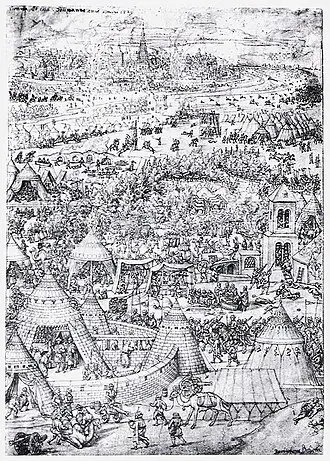
- Siege of Vienna (1529)
The 1529 siege of Vienna was the first attempt by the Ottoman Empire to capture the city of Vienna in the Archduchy of Austria, part of the Holy Roman Empire. Suleiman the Magnificent, sultan of the Ottomans, attacked the city with over 100,000 men, while the defenders, led by Ni
- Eggenberg Palace, Graz
Eggenberg Palace (German: Schloss Eggenberg) in Graz, is the most significant Baroque palace complex in the Austrian state of Styria. With its preserved accouterments, the extensive scenic gardens, as well as some special collections from the Universalmuseum Joanneum housed in th
- Anton Bruckner Private University
The Anton Bruckner Private University (in German Anton Bruckner Privatuniversität, common short form is Bruckner University) is one of five Austrian Universities for Music, Drama and Dance, and one of four universities in Linz, the European Capital of Culture 2009. Eight hundred
- Österreichische Galerie Belvedere
The Österreichische Galerie Belvedere is a museum housed in the Belvedere palace, in Vienna, Austria. The Belvedere palaces were the summer residence of Prince Eugene of Savoy (1663–1736). The ensemble was built in the early eighteenth century by the famous Baroque architect Joha
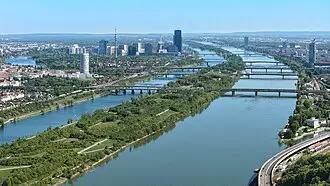
- Donauinsel
The Donauinsel (Danube Island) is a long, narrow artificial island in central Vienna, Austria, lying between the Danube and the New Danube. The island is 21.1 km (13+1⁄8 mi) in length, but is only 70–210 m (230–690 ft) wide. It was constructed from 1972 to 1988 primarily as a mea
- Historic Centre of the City of Salzburg
The Historic Centre of the City of Salzburg, also known as the Altstadt, is a district of Salzburg, Austria, recognized as UNESCO World Heritage Site since 1996. It corresponds with the historic city center, situated on the left and right banks of the Salzach river. The listing o
- Hofburg, Innsbruck
The Hofburg (English: Court Castle) is a former Habsburg palace in Innsbruck, Austria, and considered one of the three most significant cultural buildings in the country, along with the Hofburg Palace and Schönbrunn Palace in Vienna. The Hofburg is the main building of a large re
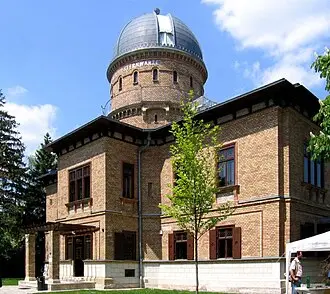
- Kuffner Observatory
The Kuffner observatory is one of two telescope-equipped public astronomical observatories situated in Austria's capital, Vienna. It is situated in the West of the city's Ottakring district, on the slope of the Gallitzinberg at 302 m altitude. Originally a private research instit
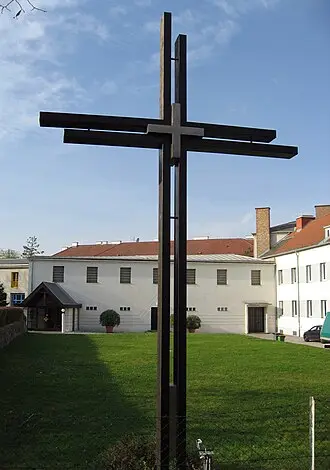
- Hasenleiten Parish Church
The Filial Church Hasenleiten (German: Filialkirche Hasenleiten or Filialkirche Zum Göttlichen Kinderfreund) is one of the Roman Catholic churches in Vienna's 11th district of Simmering dedicated to St. John Maria Vianney, and is a listed monument. On April 1, 2018, the parish of
- Lindwurmbrunnen
The Lindwurmbrunnen (German: Lindworm fountain) is a civic monument in Klagenfurt, Austria. It consists of a large sculpture of a lindworm or dragon, a statue of Hercules that is sometimes referred to as a "dragon slayer", and a fountain. It is located on the main square of the c
- Belvedere, Vienna
The Belvedere is a historic building complex and art museum in Vienna, Austria. The complex consists of two Baroque palaces, the Upper and Lower Belvedere, together with the Orangery, the Palace Stables, and a formal Baroque garden. It is located in the city's third district, Lan
- Hermesvilla
Hermesvilla is a palace in the Lainzer Tiergarten in Vienna, a former hunting area for the Habsburg nobility. Emperor Franz Joseph I gave it to his wife Empress Elisabeth (nicknamed "Sisi"), and he called it the "castle of dreams.“ The name of the villa refers to a statue of Herm
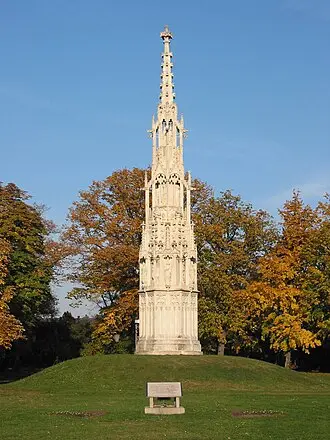
- Spinnerin am Kreuz
The German name Spinnerin am Kreuz ("Spinner at the Cross") is the title given to two separate Austrian stone-tower sculptures (over 600 years old), one in Vienna and the other in the nearby city of Wiener Neustadt. They are related to the story of a wife spinning beside a cross.
- Heiligenstadt St. James's Church
St. James's Church (German: Kirche St. Jakob) is one of two Roman Catholic churches in the parish of Heiligenstadt in the 19th district of Vienna, Döbling. It stands at the Pfarrplatz and is dedicated to James, son of Zebedee (Saint James). The church is sometimes wrongly called
- Vienna Museum of Science and Technology
The Vienna Museum of Science and Technology (German: Technisches Museum Wien) is a museum in Penzing, Vienna, Austria, on Mariahilfer Straße. The museum showcases the history and development of technology, industry, and science, with a focus on Austrian involvement. It houses num
- Battle of Vienna
The Battle of Vienna took place at Kahlenberg Mountain near Vienna on 12 September 1683 after the city had been besieged by the Ottoman Empire for two months. The battle was fought by the Holy Roman Empire, led by the Habsburg monarchy, and the Polish–Lithuanian Commonwealth, bot
- Semmelweis-Frauenklinik
The Semmelweis-Frauenklinik (English: Semmelweis Women's Clinic) was a women's clinic in the 18th district of Vienna known as Währing. It is named after Ignaz Semmelweis. The clinic was registered as a historically significant place and used to be found at Bastiengasse 36–38 in V
- Third Man Museum
The Dritte Mann Museum (Third Man Museum) is a film museum in the 4th district of Vienna, Austria. Opened in 2005, the museum has an area of over 400 square meters divided into 16 rooms, displaying a comprehensive collection of original exhibits based on and around the internatio
- Oberwart
Oberwart (German pronunciation: [ˈoːbɐˌvaʁt] ; Hungarian: Felsőőr; Croatian: Gornja Borta) is a town in Burgenland in southeast Austria on the banks of the Pinka River, and the capital of the district of the same name. With almost 8,000 inhabitants it’s the third largest town in
- Sculptures in the Schönbrunn Garden
The sculptures in the Schönbrunn Garden at Schönbrunn Palace in Vienna, Austria were created between 1773 and 1780 under the direction of Johann Wilhelm Beyer, a German artist and garden designer. The Great Parterre of Schönbrunn Garden is lined on both sides with 32 over life-si
- Austrian Museum of Folk Life and Folk Art
The Austrian Museum of Folk Life and Folk Art (German: Österreichisches Museum für Volkskunde), commonly known as the Volkskundemuseum Wien, is an ethnographic museum in Vienna, Austria. It is one of the largest museums of its kind in Europe and holds extensive collections of fol
- Battle of Aspern–Essling
In the Battle of Aspern–Essling (21–22 May 1809), Napoleon crossed the Danube near Vienna, but the French and their allies were attacked and forced back across the river by the Austrians under Archduke Charles. It was the first time Napoleon had been personally defeated in a majo
- Herzogenburg Monastery
Herzogenburg Monastery (German: Stift Herzogenburg) is an Augustinian monastery located in Herzogenburg in Lower Austria. Founded in 1112 by Augustinian Canons, the monastery was refurbished in the Baroque style in 1714 by Jakob Prandtauer, Johann Bernhard Fischer von Erlach, and
- Maria Saal Cathedral
The Pilgrimage Church of the Assumption of Mary (German: Propstei- und Wallfahrtskirche Maria Himmelfahrt), also called Maria Saal Cathedral (German: Maria Saaler Dom), is a Catholic church in the town of Maria Saal in Carinthia, Austria. Though not the see of a bishop, the churc







By continuing to use the Platform, you agree to cookies and similar technologies. If you do not agree, discontinue use.
VIDI Privacy Policy
·
VIDI Cookie Policy
By continuing to use the Platform, you agree to cookies and similar technologies. If you do not agree, discontinue use.
VIDI Privacy Policy
·
VIDI Cookie Policy