- McMurdo Station
- Villa Las Estrellas
- Zhongshan Station
- Progress Station
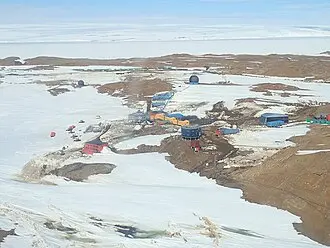
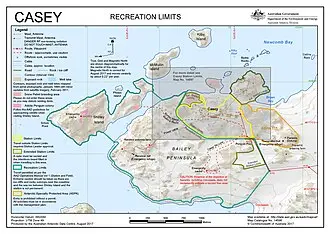
- Casey Station
- Novolazarevskaya Station
- Showa Station
- Qinling Station
- Base General Bernardo O'Higgins Riquelme
- Syowa Station (Antarctica)
Syowa Station (Japanese: 昭和基地, Hepburn: Shōwa Kichi) is a Japanese permanent research station on East Ongul Island in Queen Maud Land, Antarctica. Built in 1957, Syowa Station is named for the era in the Japanese calendar during which it was established, the Shōwa period.
- Discovery Hut
Discovery Hut was built by Robert Falcon Scott during the Discovery Expedition of 1901–1904 in 1902 and is located at Hut Point on Ross Island by McMurdo Sound, Antarctica. Visitors to Antarctica, arriving at either the US Base at McMurdo or New Zealand's Scott Base are likely to
- Great Wall Station (Antarctica)
The Great Wall Station (Chinese: 长城站; pinyin: Chángchéng zhàn) is the first Chinese research station in Antarctica and opened on 20 February 1985. It lies on the Fildes Peninsula on King George Island, 960 kilometres (600 mi) from Cape Horn. It is sited on ice-free rock, about 10
- Shirley Island
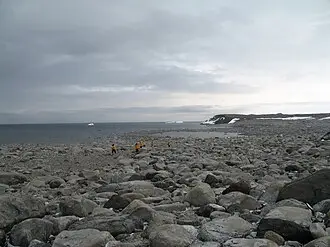
Shirley Island is a rocky island lying 200 m (220 yd) north-west of the western end of the Bailey Peninsula, in the Windmill Islands of the Budd Coast, Wilkes Land, Antarctica. It is mostly ice-free with undulating, rocky terrain. It was first mapped from aerial photos taken by
- Inexpressible Island
Inexpressible Island is a small, rocky island in Terra Nova Bay, Victoria Land, Antarctica. Previously uninhabited, the Chinese Qinling research station on the southern edge of the island became operational in 2024.
- Schirmacher Oasis
The Schirmacher Oasis (or Schirmacher Lake Plateau) is a 25 km (16 mi) long and up to 3 km (1.9 mi) wide ice-free plateau with more than 100 freshwater lakes. It is situated in the Schirmacher Hills on the Princess Astrid Coast in Queen Maud Land in East Antarctica and is, on ave
- Larsemann Hills
The Larsemann Hills are a series of low rounded coastal hills along the southeastern shore of Prydz Bay, Antarctica extending for 9 nautical miles (17 km) from Dålk Glacier. They were discovered in February 1935 by Captain Klarius Mikkelsen from the whaling ship Thorshavn, sent o
- Mount Jacquinot
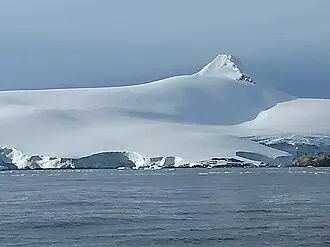
Mount Jacquinot (English: zhak-ih-NOH, French: [ʒakino]; 63°22′S 57°53′W) is a pyramidal peak, 475 metres (1,560 ft) high, with exposed rock on its north side, lying 3 miles (5 km) south of Cape Legoupil and 1 mile (1.6 km) east of Huon Bay, on the north side of Trinity Peninsul
- Chapel of the Snows
The Chapel of the Snows is a non-denominational Christian church at the United States' McMurdo Station on Ross Island, Antarctica. Initially built from scrap material in 1956, it burned down in 1978 and was rebuilt in 1989. It is one of eight churches on Antarctica and the only i
- Bellingshausen Station
Bellingshausen Station (Russian: станция Беллинсгаузен) is a Russian Antarctic station at Collins Harbour, on King George Island of the South Shetland Islands. It was one of the first research stations founded by the Soviet Antarctic Expedition in 1968. It is also the location of
- Kilby Island
Kilby Island is a rocky Antarctic island, 0.37 kilometres (0.2 nmi) long, lying northeast of McMullin Island in the entrance of Newcomb Bay, in the Windmill Islands. It was first mapped from air photos taken by USN Operation Highjump and Operation Windmill in 1947 and 1948. It wa
- Lake Priyadarshini
Lake Priyadarshini is a freshwater lake in the Schirmacher Oasis, Antarctica. It supplies water for Maitri, India's second permanent station in Antarctica. Lake Priyadarshini was named after the then Prime Minister of India Indira Priyadarshini Gandhi.
- Hut Point Peninsula
Hut Point Peninsula (77°47′S 166°51′E) is a long, narrow peninsula from 2 to 3 nautical miles (3.7 to 5.6 km; 2.3 to 3.5 mi) wide and 15 nautical miles (28 km; 17 mi) long, projecting south-west from the slopes of Mount Erebus on Ross Island, Antarctica. McMurdo Station (US) and
- Ardley Island
Ardley Island is an island 1.9 kilometres (1 nmi) long, lying in Maxwell Bay close off the south-west end of King George Island, in the South Shetland Islands of Antarctica. It was charted as a peninsula in 1935 by Discovery Investigations personnel of the Discovery II and named
- Clark Peninsula
Clark Peninsula is a rocky peninsula, about 3 km (2 mi) long and wide, lying 5 km (3 mi) north-east of Australia's Casey Station at the north side of Newcomb Bay on the Budd Coast of Wilkes Land in Antarctica.
- Albert P. Crary Science and Engineering Center
The Albert P. Crary Science and Engineering Center (CSEC), located at McMurdo Station, was dedicated in November 1991 by the National Science Foundation (NSF). The laboratory is named in honor of geophysicist and glaciologist Albert P. Crary. There are five pods making for 4,320
- Trinity Church (Antarctica)
Holy Trinity Church (Russian: Церковь Святой Троицы) is a small Russian Orthodox church on King George Island near Bellingshausen Station, a Russian research station in Antarctica. It is one of the eight churches on Antarctica and the southernmost Eastern Orthodox church in the w
- Observation Hill (McMurdo Station)
Observation Hill is a steep 754-foot (230 m) hill adjacent to McMurdo Station in Antarctica and commonly called "Ob Hill". It is frequently climbed to get good viewing points across the continent. Regular clear skies give excellent visibility. A memorial at the top of the hill,
- Monument to the Antarctic Treaty
The Monument to the Antarctic Treaty commemorates the signatories of the Antarctic Treaty, which was opened for signing in 1959 and came into force in 1961. The monument stands near the Frei, Bellingshausen and Escudero research stations on the Fildes Peninsula of King George Isl
- Arrival Heights
Arrival Heights are clifflike heights which extend in a north-east–south-west direction along the west side of Hut Point Peninsula, just north of Hut Point in Ross Island, Antarctica. They were discovered and named by the British National Antarctic Expedition, 1901–04, under Robe
- Chapel of St. Mary Queen of Peace
The St. Mary Queen of Peace Chapel (Spanish: Capilla de Santa María Reina de la Paz) is a Catholic chapel located in Villa Las Estrellas, in the Chilean Antarctic Territory (claimed by Chile), which includes in the commune of Antártica, within the Region of Magallanes and Chilean
- Gemel Peaks
The Gemel Peaks (62°11′42″S 58°59′36″W) are two peaks 1.3 nautical miles (2.4 km) northeast of Horatio Stump on Fildes Peninsula, King George Island, in the South Shetland Islands. They were charted and named "Twin Peak" or "Twin Peaks" by Discovery Investigations personnel on th
- Lapidary Point
Lapidary Point (62°11′48″S 58°56′01″W) is the southwest entrance point to Rocky Cove, Maxwell Bay, King George Island, Antarctica. It was named "Mys Kamennyy" (rocky cape) by G.E. Grikurov and M.M. Polyakov in 1968, following Soviet Antarctic Expedition surveys in the area. This
- Law-Racoviță-Negoiță Station
The Law-Racoviță-Negoiță Station (Romanian: Stația Law-Racoviță-Negoiță), known only as the Law-Racoviță Station (Stația Law-Racoviță) until 2011, is the first Romanian station for research and exploration in Antarctica, named after the Romanian explorer Emil Racoviță and inaugur
Museums, religious and historic sites, nature — with photos, descriptions and directions





By continuing to use the Platform, you agree to cookies and similar technologies. If you do not agree, discontinue use.
VIDI Privacy Policy
·
VIDI Cookie Policy
By continuing to use the Platform, you agree to cookies and similar technologies. If you do not agree, discontinue use.
VIDI Privacy Policy
·
VIDI Cookie Policy